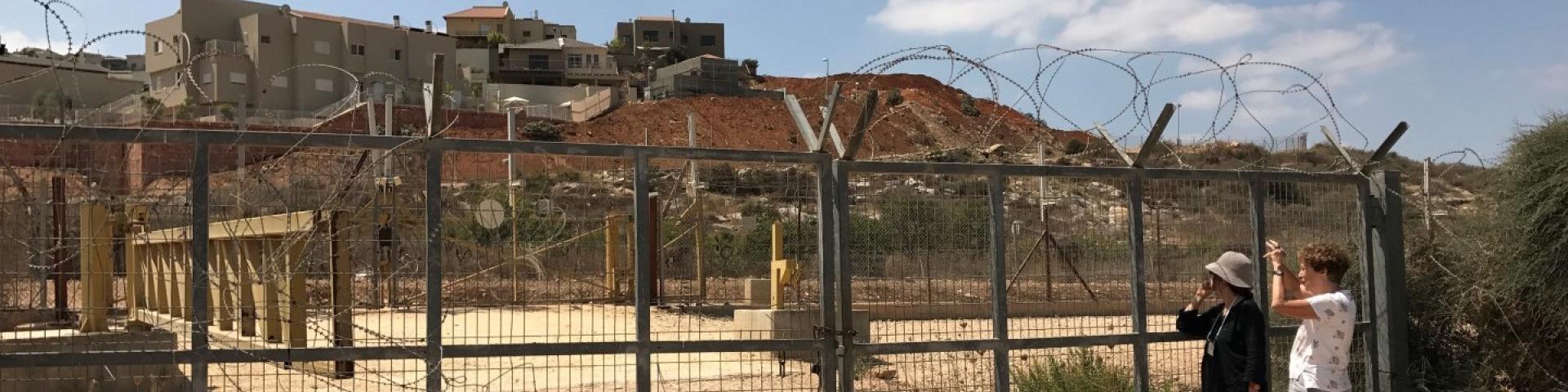
Falamiya
Ordinary day, sun shining and the occupation continues as usual. A childrens' bus went through with no problem at Habla.
06:10 'Azzun 'Atma
A lot of people outside; medium sized line of about 60 waiting; someone we marked went through in about 20 minutes - not bad for this location. The turnstile is operating and a number of people are allowed to go through each time it and to wait until a turn is ready at the inspection booth. Now there is also a magnometer and those approaching remove their belts before they arrive and empty their pockets. In this way, they go through quickly without any delays. Some of them are already experienced - not like in the terrible days of Beit Iba, when every other person would get stuck in the magnometer because he had left something in his pocket, or his shoes set off the alarm. There is also an inspection table between the two booths and, if someone finished the check and has equipment with him, returns to an additional gate which a soldier opens for him and behind which he can leave his stuff, and he goes through an inspection by hand. And to "freedom" in the State of Israel.
One illegal infiltrator was caught going through a hole in the fence and brought back to the checkpoint - we didn't see what happened to him, because we noticed this only after we had left for the house of the coffee salesman. There is a huge rip of about 3 meters in the fence to the east of the checkpoint, already there for several weeks, but they don't fix it, just run after the infiltrators to hunt them down. Always successful - but that depends on for whom.
07:00 Habla
The childrens' buses arrive and go through, except for one that has a huge rock caught in the wheel - after a lot of pushing and pulling and banging, the stone was released and they could go on their way. There is no one left in line, and those coming now are particularly those with tractors, wagons, vans, and they go through quickly.
08:00 Falamya
Pastoral as usual and only remains of black on the floor next to the gate and on the gate are reminders of the fire that was set here during the demonstrations a few weeks ago. People come constantly, little by little, wagons with horses, vans, go by after inspection.
08:30 Jabara
We wanted to see how the new fence is coming along - and, in fact, it isn't finished yet but, when we went up to the highest place in a-Ras, we could see that it is already paved and looks really "nice". But it is not yet connected to the old fence beneath a-Ras. One can also see them working on the fence next to Jayyus.
The occupation routine at 'Azzun 'Atma: hunting people in Israel illegally.
06:16 The road from the Oranit terminal to 'Azzun 'Atma – Some cars are parked on the road; perhaps there had been an accident. There’s also a police car and a car in the middle of the road. It seems strange, until we notice a number of Palestinians and a police officer on the roadside and another who comes running from the road into the field. We stopped and went to see what was happening: a few Palestinians fleeing through the field to the 'Azzun 'Atma fence, chased by a police officer. We hear a shot, but nothing happens as a result. The police officer who ran along the road joins his pursuing colleague. The police officer standing next to the Palestinians is holding something that looks like a shiny, sparkling, silver pistol which he puts in their car. A Taser?
Meanwhile the men fleeing have disappeared into the olive grove, followed by the police officers. The group detained by the roadside (four young men and one older man) is gathered around the police officer, conducting some kind of dialogue with him. One stumbles; it looks like he has trouble walking. At one point he lifts his shirt to show his companion his back. Had he been hit by the Taser?
It’s clear that the young men went through a hole in the fence to the road trying to get a ride to work in Israel, without permits.
After 15 minutes, the pursuers returned empty-handed. A discussion is held with the youths who were caught; they give their IDs to the police officers. We decided to continue to 'Azzun 'Atma, expecting the group to be brought there. Meanwhile all the cars drove away, except for the police car and the one standing in the middle of the road.
06:45 'Azzun 'Atma – Many laborers are waiting outside; the line is short and advances rapidly. The revolving gate is finally working, allowing the soldiers to control the crossing and prevent congestion.
We didn’t see the young men who were caught. When we returned to that spot we saw them still standing there with the police officers.
07:15 Habla checkpoint – Many have already gone through; people cross in record time.
07:25 The children’s buses arrive and cross quickly. There seem to be more people than usual today, but it doesn’t slow down the crossing. Everyone’s smiling, saying hello to us; the occupation routine.
08:00 Eliyahu gate – Cars are being inspected; there is no line at the pedestrian crossing.
08:15 Falamya checkpoint – Quiet. Signs of the fire are still visible next to the repaired gate. A flock of sheep arrives, goes through without inspection. Carpets of hyacinths are in full bloom along the way – magnificent. A constant trickle of people at Central West Bank
The agricultural gate at Falamya was closed because of a demonstration. The childrens' buses at Habla went through quickly.
06:05 'Azzun 'Atma
Many people have already come through; the gate is open and, behind it, is a line of about 60 people waiting. Every time, the same number of 4 people go through for inspection; when those are checked and released, another 4 go forward toward the gate. All the rest stand about one meter back from the gate; among them are soldiers who are watching them so that "they don't fight and so that they stand in line correctly". It is for their own good, the soldier tells me, because passing is fast which is to their advantage. During the time we were there, in spite of the fast passage, the line never got shorter since there were additional people coming all the time.
06:55 Habla
The soldiers have already opened the gate here, and at 07:00 the first people go through into the checkpoint. Here, as usual, the passage is slower than in 'Azzun 'Atma, but there is progress. In addition bicycles arrive, a wagon with horses, donkeys and a herd of sheep is allowed to cross to the grazing land along the border, after this has been denied them for more than 2 months by our authorities. They were punishing a shepherd, or, more exactly, his herd, for what the shepherd did which was not acceptable. At 07:20 the childrens' buses arrive and go through smoothly.
We continued by way of Eliyahu gate - 5 cars are being inspected and 5 wait in the pedestrian lane. On the way back, no one was in the pedestrian lane and there were also no cars awaiting inspection. The inspections were the same, with the dogs and everything.
'Azzun is open, there is no obstacle to entering the village.
It was quiet when we arrived, only a tractor with 4 passengers came to the gate - it makes a U-turn and returns. Strange.
And then we understood. The gate is closed and locked and there is no one in sight. No soldiers. In front of one of the closed gates, one can see a darkened area, as well as the gate itself, and then we understood that there had been a fire here. The tractor driver explained that a fire had been set yesterday, like in Jayyus a week ago. We hadn't known about that.
We rang the DCO, and they said that the gate had been set on fire yesterday evening and that they didn't know when it would be fixed, maybe today or tomorrow, but meanwhile there is no plan to open the gate, and there is also a technical problem as a result of the arson in opening it. He also said - they are "shooting themselves in the foot". We will follow-up by contacting the tractor driver again.
All this and we can only report that no one can claim that they didn't know there was any problem with the occupation, that it is awful, that civilians are oppressed and also "shoot themselves in the foot", since it apparently is no longer painful. During the past weeks, we frequently see things that the Palestinians do which could be called civil rebellion, even though it does harm their livelihood.
We continued to Madma in order to get the signature of a man on a petition to the court to release him from his status as "forbidden to work in Israel".
A regular occupation day; buses full of children arrived at the Habla crossing, inspection included the contents of the buses.
06:10 Azun Atme
A lot of people already standing outside the checkpoint, waiting for transport. Only about 30 in line, and they are going through quickly; all the time new people are arriving. A little after our arrival, the checkpoint commander appeared and sent us to stand in the back - we moved a bit, so that we could still see what was happening, but then he returned and started arguing with us, announcing that this was a closed military zone and we had to get farther away. We tried to insist that he show us the order stating that this had been declared a closed military zone, but he didn't have one; nevertheless, he was quite violent in his manner and we didn't have the stamina to oppose him. Clearly, he had received direction from above or from his friends, not to allow us to stand there. So we moved little bit once again. Anyway, beyond just "showing him" that we were allowed, there wasn't any particular importance in insisting, as things were moving along correctly at the checkpoint, it was a well-organized checkpoint and there were no particular problems.
06:55 Habla
The soldiers opened the gates (the checkpoint was due to open at 07:00), and the first people went through a few minutes earlier than 07:00. A lot of people in line and, next to the checkpoint, there was a civilian car on the patrol road with a license plate on which was written "Ta'oz company, tour of Gates". Strange. Has that also been privatized? Are there civilian "companies"? The crossing itself was very fast in comparison to previous times: 50 people went through in 20 minutes. There were also donkeys and carts and mules and cars. One of them belonging to a man from the Ramadeen clan, was full of things which had to be taken out for a thorough inspection. The gate for vehicles/carts was not opened all the way by the soldiers, creating a traffic jam of cars coming in and out of the West Bank.
07:25
The girls' bus arrived and went through inspection on its way to Habla; a few minutes after, the boys' bus arrived and also went through inspection before they were allowed to continue to school, while the buses had to make a slalom run through the gates.
07:45 Eliyahu Gate
4 vehicles being inspected; no one in the pedestrian line.
08:00 Falamiya
Tractors going through to their fields. Quiet, pastoral atmosphere. One man sitting at the entrance to the checkpoint. They had taken his permit and he doesn't understand why or what is happening. We decided to wait a few minutes before troubling the DCO; after those minutes, a man returned with his permit and he left for the fields. More tractors arrived, as well as trucks, and they went to the orchards.
We called the village head from Ras a-Tirah in order to find out if Gate 1360, which the soldiers had claimed that they opened before they open at Habla, was really the gate from Ras a-Tirah in the direction of the orchards, next to Alfei Menashe, and indeed it was this gate. He also said that they had opened it for 2 weeks but, during the first week, it had rained and it was impossible to work. This week, they are waiting for the ground to dry a little and by then the time will have gone by and, once again, they will not be able to plow. They simply must lengthen the period during which plowing is allowed.
We went up to Kufr Jammal, to the grocery, to find out if they were allowed to go out to the orchards where the gates had been closed during the whole year, except for during the olive harvest. It turned out that they were not allowed to get to the orchards to plow, the matter is still being taken care of. Also in this case, we complained that, last year, it had rained during the whole 2 weeks and they were not able to get to the orchards to do their work.
Ordinary day of occupation. The passage at 'Azzun 'Atma is slow, at Habla everything is as usual. The children are still on vacation.
06:05 Entrance from Oranit in the direction of Tamar Gate
There is light beside the gate and it is clear that the army is already there. Soon we see figures in the dark coming towards us on the road where the gate is open. They say that everything is quiet.
06:30 'Azzun 'Atma
There are a lot of people waiting outside on both sides of the road. A lot of bonfires have been set up to warm those waiting for transport. There are about 70 people in line, which is relatively a lot compared to recent days when we were here at the same hour. The passage is rather slow because, like a week ago, the soldiers close the gate and every time that 2 people pass inspection they open the gate again; two more enter and they close the gate again. After I photographed what was happening, a soldier came up to me in anger and asked to check that I hadn't photographed him. I showed him the pictures and we explained to him how his work method was slowing down the passage of people - which was something we wished to show in the photos. We spoke about the serious difficulty for the people standing in line, day after day, not for pleasure - discotheque - but because they had to go to work to support their families.
Afterward, when it was his turn to operate the gate, he did leave the gate open and, every time that someone got to the inspection booth, he already let the next one in line move forward in line through the gate. It really did make the whole operation more efficient. During this entire period, the line did not decrease, as people kept coming .
They are working on the side of the road with huge equipment on the southern side and also at the entrance to Shaarei Tikva. It seems that the fence will be moved in such a way that the residents of Shaarei Tikva and their friends will have a new entrance and all the area of the entrance will apparently be returned to'Azzun 'Atma . It isn't clear what was the point of this huge investment in improving the checkpoint. But perhaps they misled us and it isn't going to be moved elsewhere. What is certain is that there will be a new fence around'Azzun 'Atma or, as the Palestinian Israeli worker told us, they are creating a separation fence for it.
07:15 Habla
There are almost no people; whoever arrives takes only a minute for inspection. There are a lot of wagons and cars going through in relation to previous days. The children are still on vacation - another week and a half, and one is quite conscious of them accompanying their parents to work.
07:50 Eliyahu Gate
4 cars are being inspected and very few people are waiting in the pedestrian line. There is a new shed at the entrance for inspection on the pedestrian line, and another
shed farther down the path where they must walk, around the checkpoint, in order to reach the road and continue on their way.
08:15 Falamya
It is quiet as usual at this hour; nevertheless, people continued to arrive with wagons and cars with work equipment to go to the fields. There are a number of children among them who joined their parents, even 3 small children, maybe 4, 6 and 7, who went out with their parents to the field or the grove. At a certain point there was even a short line at the inspection booth.
We continued by way of Jit to Deir Sharaf. The hills are already green, with wildflowers blossoming as well as almond trees in honor of Tu b'Shvat.
09:10 Shavei Shomron - no checkpoint, free passage.
In the shop at Deir Sharaf they told us that life isn't so bad, but there isn't enough work and everyone must get permits to work in Israel. If they would only let us work, all of us would be satisfied and everything would be fine.
--
13:00 Habla - A vehicle from the Ta’oz battalion arrives and its occupants get to work. Six Palestinians, a horse cart and a tractor are waiting. The gate doesn’t open because the female MP isn’t able to open the door of the inspection building. We can see 10 people and a number of vehicles waiting from the other direction.
13:08 The staff finally solves the problem and the gate opens. The first five people enter and go through to the village in two minutes.
13:10 The first five coming from the village approach the revolving gate.
A Palestinian living in Jaljulya asks the soldier for permission to cross for a minute to the other gate to receive something from his brother who’s arrived from Habla, without having to go through inspection. The soldier agrees, escorts him. A welcome flexibility; too bad we don’t witness it more often.
One of those waiting says to us: “If we’re a minute late they don’t let us through but they’re allowed to be late opening the gate.”
13:17 Crossing continues with no problems. A large truck carrying two olive trees comes from Habla, followed by a cart and tractor. A flock of sheep, escorted by a shepherd and small boy.
Everyone who arrives crosses without delay.
13:30 We leave.
13:35 Eliyahu crossing – People cross quickly. No lines.
14:00 Azzun – We stop at Z’s shop to leave parcels. He greets us with a big smile, as usual. He hasn’t yet received the results of his tests at Ichilov Hospital.
14:10 Jayyous – A quick stop at N’s house to buy olive oil.
14:20 Falamya – More vehicles than usual, some waiting, others going through. Only those entering are inspected.
A person blacklisted by the Shabak approaches us; we give him Sylvia’s phone number.
14:40 A Palestinian arrives in his vehicle. He gets out, enters the inspection building. He emerges two minutes later. The vehicle is inspected and he drives away. The driver of a vehicle who came to pick up relatives tells us, in English: “You could travel all around the world without finding a place as tough as this. All day long we’re kept busy obtaining permits and being inspected. It’s awful.”
We agree.
We drive north.
15:10 A bulldozer is working in the wadi on our way from Kafr Sur to Beit Lid.
15:15 Beit Lid – We meet a student from Al Najah in the grocery, who speaks English. He says things are usually quiet. There were problems only during the olive harvest season.
Tractors and bulldozers at work at the exit from Beit Lid, apparently widening the road.
15:30 Anabta checkpoint – Cars pass quickly without stopping. We don’t see soldiers or the coffee-seller.
15:50 Shufa – The checkpoint is open. The huge concrete cubes still lie by the roadside as a reminder of times past. A large red sign was added recently.
16:00 Te’anim checkpoint – Careful inspections of Palestinian vehicles with the help of dogs. I managed to photograph. Earthmoving equipment continues to be busy.
16:05 Efrayim checkpoint – Irtach - Heavy traffic at this hour. Many Israeli vehicles dropping workers off at the checkpoint. Hundreds hurry home. Some of the Palestinians keep asking us to come in the morning. “It’s hard, hard – a real battle in the morning,” they say.
Three empty buses wait. We weren’t able to find out why.
16:30 We leave.
The children are on mid-year vacation for a month. The high school students are still studying, but only until the end of the week. At the 'Azzun 'Atma checkpoint, they decided to get organized and to teach the Palestinians a lesson in organization.
06:00 Entrance to Tamar Gate - We come from the direction of Oranit. The Gate to the road leading to the Tamar Gate is open and, at the entrance road, a military vehicle is driving in front of us. When it reaches the Gate, it turns around and comes back toward us. "It is forbidden for you to be here. Get out!" After a short discussion, we decided to give in so that they would go and open the Gate.
We drove to the other end of the road, which is close to the Gate of 'Azzun 'Atma and, after waiting about 5 minutes, a number of Palestinians arrived. They said they were working nearby and it was easier to go out through the Tamar Gate, even though most of them were going to work in the direction of Oranit. In order to leave the area, they had to push the two wings of the closed Gate outward; thus the locked space between the wings is wide enough so that pushing on them, made it possible to duck down and get through the locked chain.
06:30 'Azzun 'Atma - there are people outside. Not a lot. Bonfires are warming some of them and other are behind a new guard wall which was erected on the road which gives a little protection against the cold. It was really cold; 7 degrees, according to my car thermometer.
There are about 50 people in line and 2 inspection stations as well as soldiers keeping order. Those waiting are in line and have to go through a gate. The gate is sometimes locked and, even when it is open, they only let one person at a time through after the person in front of him has finished his inspection. They constantly tell the people in line to go back, stand in order, and they are standing 2 meters from the gate. But, according to the basic laws of physics, when there is a space, it fills up and the line is always moving forward a bit and then everyone is sent backward to get in order; until they are sufficiently organized in the eyes of the soldiers, no one goes through and the line lengthens. It reminds us of the horrible days of the checkpoints in Hebron, and the shouts "Irgeh l-wara!" (go back!). A soldier comes over to find out why we are there and says, in our conversation, that "there must be order". I told that that was how it was once in Germany and tried to explain to him, something he doesn't seem to understand, that the people here are not soldiers and they are just simple workers who are dying to get to work and earn a living, and what they need is a little empathy and not a lineup. I don't know if this made any impression.
07:10 Habla
Outside, and in the nurseries, there are already workers who have passed through. At the entrance to the checkpoint (opens at 06:30) there are donkeys and wagons. There is no line at the checkpoint, whoever arrives go through, and everyone is satisfied because it opened earlier than usual in the morning. Tractors go through in both directions, and a boy who is waiting in the shed for his father, who went to bring the wagon, told us that the children are on vacation.
07:50 Falamya
A number of women are waiting. A tractor with irrigation pipes is inspected, and then another one - took them each 5 minutes to go through. The soldiers came over to ask who we are, and were amazed at our tenacity in coming to such a place. I explained to them that, in my 9 years in Machsomwatch, I was attacked only by settlers. A private car passes, a real "highway" today.
One woman is sent back, poor thing. Her permit expired today and she hadn't noticed. We took her back to Jayyus, from where she had come on foot.
Ordinary day of occupation. The children are on "vacation" as there is a strike of the employees of the Authority, the teachers and many others. This is because they did not receive a salary last month.
On the way, we saw a lot more use of donkeys than in the past. Even on highway #55, in the area between Eliyahu gate and the gas station of Alfei Menashe, there were a number of wagons with passengers and donkeys pulling them.
06:20 'Azzun 'Atma
Many are already waiting outside, but the line has about 70 people or more, even though the inspection is quick - 30 people went through in 8 minutes. The building of the checkpoint is proceeding at a good pace and every time something new has been added "to the advantage of the residents". Now it is a kind of divider, half transparent, between the vehicles lane and the inspection lane for pedestrians.
06:45 Tamar gate
We travelled by way of Oranit. Also, on this side of the road which leads to the gate, there is an additional gate, which cuts off the road coming from the Tamar gate. Pedestrians arrive and form a line between the gate and the fence. One can also pass through the gate if you push with both shoulders, but, in principle it is locked and there is only the hole in the fence. On both sides of the gate they are working on the new fence. It looks as though it will increase the amount of land returned to Palestine on one side but, along the road to Oranit it will decrease the space. There is also a lot of work on the south side of the road to Elkana - are they continuing the fence to there?- we'll see.
07:15 Habla
There is no one in line, even though the gate opened at 06:30; it is not usual that 45 minutes after the opening there is not yet a line. The children didn't cross because of the school strike. People keep arriving, but go straight through in both directions.
Eliyahu gate- 3 vehicles for inspection, no pedestrians waiting in line; there is a new shed in the pedestrian area, but not near the inspection booth.
We traveled to 'Azzun to our friend, Z., to bring things for his store. It is pleasant to report that he is enterprising and intends to open another store, so he will sell men's wear alone and his wife will sell the women's wear. However, his medical situation has not improved.
08:00 Falamya
Quiet as usual; vehicles go through, tractors and donkeys. All of them with children - vacation, so they can help with the work
09:30 Jabarra checkpoint
Quiet, only a few people going through but the checkpoint still exists. According to the soldiers, they will dismantle it in another 1-2 months; a Palestinian said in another 20 days. So we decided to go and check how the fence is coming along. We went up to Ar Ras (next to the mosque) where there is a very good lookout. We saw that the fence is far from being completed (in the area under the rocks), and it doesn't look as though the Jabarra checkpoint will be dismantled. We will follow up.
05:50 'Azzun 'Atma'
A large number of laborers wait outside, warming themselves at small fires. A very short line at the exit.
The reservists are very efficient and polite. There is a lot of new construction at the checkpoint; there’s no doubt it will be here forever…
New procedures have been instituted at the checkpoint. It opens from 05:00 to 07:00. After 07:00, only holders of special permits and those with 00 ID’s who are permitted to stay overnight in Israel are allowed to cross. Soldiers are on site all the time to open the checkpoint if necessary.
(We received this information from the current checkpoint commander – a reservist ; I recommend reconfirming it on other days and at other times.)
06:20 Tamar checkpoint
According to the information we were given, this checkpoint is also open from 05:00 to 07:00, but when we reached it at 06:20 the gate was locked. We drove to the other end, closer to Oranit, where many large trucks and giant bulldozers are paving the route of the new fence and the new wall surrounding Oranit. The gate here was also closed, but as we arrived we saw a military vehicle and a female soldier opening the gate to two Palestinian buses driving toward 'Azzun 'Atma. There was no one we could ask about them. The soldier drove to Tamar gate, near 'Azzun 'Atma, and opened it at 06:30 exactly for Palestinians who crossed on foot and walked toward Oranit and Kafr Qassem.
It turned out that, as of 1.12.12, all the gates again open at the usual winter hours that were in force before the olive harvest began.
A DCO officer who was there (I forgot his name) told us the Tamar gate opens from 06:30 to 07:00.
The guard at the construction site is a Bedouin from the north. He served three years in the army, as did his father and grandfather. But he said he couldn’t get a job with the Israel Electric Company after he was demobilized, or with the Israeli Railways or the Israel Lands Administration. He’s very angry at the State.
We observed the settlement of Oranit which doesn’t require special decisions by the government to expand and conquer more and more lovely hills covered with olive trees. The locality is surrounded by a wall which also encompasses hills on which there’s no construction yet.
07:10 Habla
A printed notice is posted on the gate, specifying the new hours it’s open.
Morning: 06:30 – 08:00. Afternoon: 13:00 – 14:00. Evening: 17:00 – 17:30.
The plant nursery that sprung up next to the gate is expanding. Rows of adult olive trees for sale along the road to the checkpoint.
The pink schoolgirls’ bus waits at the gate; the veteran driver is being inspected. When he returns to the bus he drives to the area between the two gates, stops and the bus is carefully checked, including the empty baggage compartment. Remember – the children’s bus comes from “Israeli territory” to the Palestinian village!
Inspections proceed slowly; it takes five minutes for each group of five laborers. One of laborers emerges very angry at the female MP who treats the Palestinians like dirt. As best as we’re able to see, not many people wait to cross. The “plant nursery coordinator” arrives at the gate and asks why the laborers are being delayed. He addresses the checkpoint commander by name. He tells us that he owns the largest plant nursery; the olive trees near the checkpoint are his. We’re astonished when he tells us he buys them from the Keren Kayemet; they come from the Beit Shemesh area. He doesn’t bring olive trees from the West Bank! He speaks excellent Hebrew. He says he’s in contact with the DCO officers on behalf of the plant nurseries and their workers. He says more wells are planned between the plant nurseries and the fence around Qalqilya so more land can be cultivated; it’s not being worked today because there’s not enough water.
07:00 Eliyahu gate
No people on foot; a few cars being inspected at the facility.
08:05 Falamya agricultural gate
We see a road being paved into the area beyond the fence. It turns out that the Jayyous municipality, with the army’s permission, is financing the paving of roads between the fields and the orchards for the residents’ benefit!
We meet Ma’azuz, Jayyus’ deputy mayor, in a car inside the checkpoint. He hadn’t noticed that the car’s permit had expired December 1, and despite phone calls to the DCO he wasn’t allowed to cross with it even though he goes through every day to deal with paving the road. The soldiers tell him that if the DCO authorizes him to cross there’s won’t be any problem. I give him Tedesa’s phone number, who tells him that he must go to the DCO to renew the permit.
The hours that the Jayyus agricultural gate is open:
Morning: 05:30-06:30; Afternoon: 13:00-14:00; Evening: 17:00-17:30.
Ma’azuz says that 05:00 is too early in the morning – it’s still dark – and 17:00 in the evening is too late – it’s already completely dark.
After a long conversation we part; Ma’azuz sends regards to Anat and Dalya and drives to the DCO.
08:55 We return via the Eliyahu gate.
Our guest is stunned at what we saw today. For me, it was a pretty normal day as far as the occupation is concerned.
Translation: Judith Green
6:15 Elyahu Gate - A lot of people waiting in the pedestrian line; we didn't stop, because we wanted to get to Jayous at a reasonable hour and, because of a misunderstanding, we got a late start. .
6:35 Jayyus - the gate opened at 6 and, when we arrived, the Ecumenical group were already there and counting the people passing through. A number of tractors, van and wagons with families went through on their way to the olive harvest. At 7:05 the checkpoint closed.
7:35 - Falamiya - Quiet as usual at this hour. Every once in a while a tractor arrives with a number of workers, families and one family who went through by foot to their fields/ orchards, after leaving their car at the checkpoint, as it didn't have a permit. We continued to Zuhair's grocery to hear what is happening in the village of Jemal. They confirmed that they had received permits for the harvest (thanks to the intervention of Ronni and Miriam), and some of them had already finished the harvest. There were no special problems, thank goodness.
9:30 Eyal crossing - We decided to look in, since some Palestinians had told us that there were hours during which the crossing was halted, in spite of the fact that people were waiting to go through, but it seemed to them that the progress was halted until enough people had gathered into a serious line and only then did they open the gate. We met a DCO officer who told us that there was no problem there and that he made sure that the crossing was always open, even though sometimes there were only a few inspection booths. It is worthwhile to go there at about 7 in order to witness what happens. Perhaps we will try next week. While we were there, only one man went through, but it was really a late hour for going to work or for some other commercial business. Several people returned as they had not found work.