
Fuqeiqis - expansion of settlements
Driving on Route 60 on the way to Khursa one sees a sign a few hundred meters to the left. This refers to the regional emergency centre, South of Mount Hebron – Beit Dror (Named for Col. Dror Weinberg of the Yehuda Brigade who was murdered in the second intifada).
We went in to see the building surrounded by wire fences, and several cars parked.
According to Google the building dates back to the days of Jordanian rule and was initially converted into a regional emergency centre, near the Engineering Corps base that was established next door. In 2009, the engineering base was dismantled.
In 2016, several families settled in the said building and today it houses 17 families. It is no longer an emergency centre, but a settlement.
We continued to Khursa. The pillbox, which is in the middle of a main street with barriers on both sides and wire fences around it, is a reflection of the apartheid that is being talked about more and more.
Yusuf says that after the attack at the Sheep Junction on August 21, 2023, in which the late Bat Sheva Nigri was murdered, all checkpoints were closed for two days to Palestinians only of course. Open to settlers…what else?
Aaccording to him, the army patrols have been reinforced.
Every week, the soldiers in the pillbox go back to their homes and businesses, and according to what soldiers come the attitude towards the Palestinians changes.
From there we went to the Jadallah family in Fuqeiqis.
Upon our arrival we saw a concrete pump in action.
I went up to the upper balcony. From there you can see some of the houses of the Negohot settlement, which was established in 1982, close to the Palestinians, a few tens of meters away.
From the balcony of the Jadallah family you can see the area that has been levelled for several months.
The government’s policy to take over the territories occupied by Jews is being implemented.
Hakvasim (sheep) Junction
See all reports for this place-
One of the roadblocks (earthworks, rocks, concrete blocks or iron gates) that prevent transit of vehicles to Route 60 in the southern West Bank and block the southern entrance to Hebron. A manned pillbox supervises the place.
-
South Hebron Hills
See all reports for this place-
South Hebron Hills
South Hebron Hills is a large area in the West Bank's southern part.
Yatta is a major city in this area: right in the border zone between the fertile region of Hebron and its surroundings and the desert of the Hebron Hills. Yatta has about 64,000 inhabitants.
The surrounding villages are called Masafer Yatta (Yatta's daughter villages). Their inhabitants subsist on livestock and agriculture. Agriculture is possible only in small plots, especially near streams. Most of the area consists of rocky terraces.Since the beginning of the 1980s, many settlements have been established on the agricultural land cultivated by the Palestinians in the South Hebron Hills region: Carmel, Maon, Susia, Masadot Yehuda, Othniel, and more. Since the settlements were established and Palestinians cultivation areas have been reduced; the residents of the South Hebron Hills have been suffering from harassment by the settlers. Attempts to evict and demolish houses have continued, along with withholding water and electricity. The military and police usually refrain from intervening in violent incidents between settlers and Palestinians do not enforce the law when it comes to the investigation of extensive violent Jewish settlers. The harassment in the South Hebron Hills includes attacking and attempting to burn residential tents, harassing dogs, harming herds, and preventing access to pastures.
There are several checkpoints in the South Hebron Hills, on Routes 317 and 60. In most of them, no military presence is apparent, but rather an array of pillboxes monitor the villages. Roadblocks are frequently set up according to the settlers and the army's needs. These are located at the Zif Junction, the Dura-al Fawwar crossing, and the Sheep Junction at the southern entrance to Hebron.
Updated April 2022
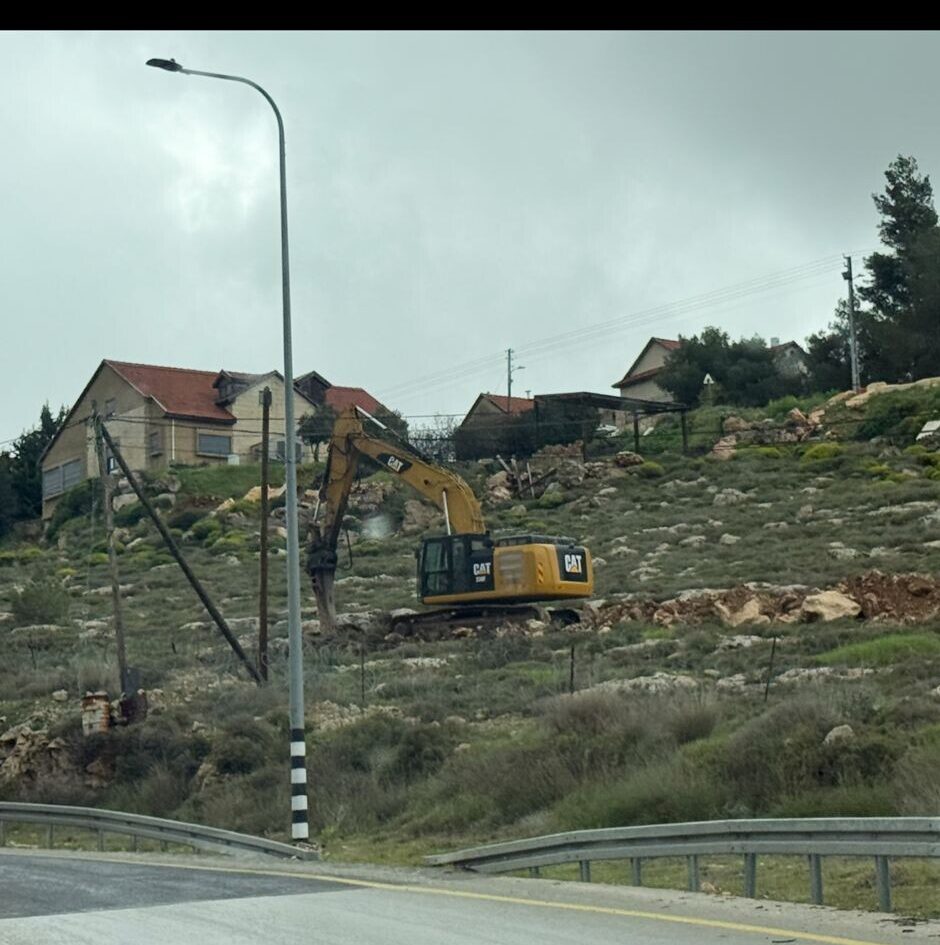 MuhammadFeb-24-2026South Hebron Hill, Beit Hagai: Paving an internal security road
-