
A UFO landing zone in the middle of the checkpoint?
“For fifty years we have been told that the Occupation will end. For fifty years we keep saying the Occupation will end. Fifty years and it’s only getting worse” said an acquaintance of mine as we sat down for coffee.
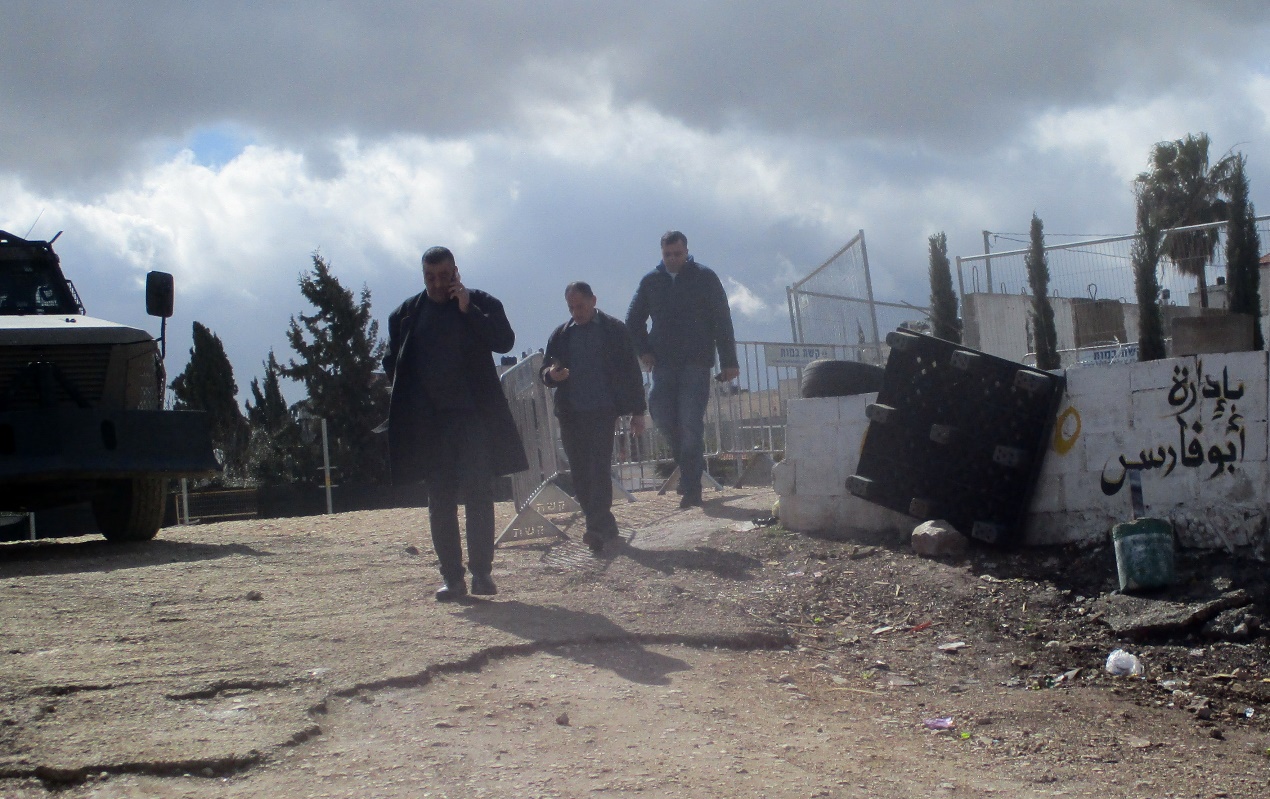
First they confiscated the car park at the front of the checkpoint, demarcated the area with tin sheets, crushed the asphalt to smithereens, heavy equipment worked tirelessly, digging, razing and destroying.
When the entire area became a pile of rubble, circular lanes were paved at varying heights.

I don’t know whether this is an interim phase or the finished product, but those who come here have nowhere to park and probably won’t in the future, at least not in the foreseeable future.
Whoever comes from Jerusalem to the West Bank or vice versa and must cross this compound as a pedestrian, has to be careful not to trip among stones nor fall down slopes or make an effort climbing uphill.
The onlooker at this stylishly paved area might think she has accidentally happened upon a UFO landing strip.
So where does one park one’s Palestinian vehicle?
Either far away, or crowded at the roadside behind, where fast grabbers have taken over and charge protection fees. Whoever improvises, parking at the edge of this quasi-renovated car park might find a parking ticket on his windshield upon her return to the car. After all, this is Jerusalem municipal area, isn’t it?
Qalandiya Checkpoint / Atarot Pass (Jerusalem)
See all reports for this place-
Click here to watch a video from Qalandiya checkpoint up to mid 2019 Three kilometers south of Ramallah, in the heart of Palestinian population. Integrates into "Jerusalem Envelope" as part of Wall that separates between northern suburbs that were annexed to Jerusalem in 1967: Kafr Aqab, Semiramis and Qalandiya, and the villages of Ar-Ram and Bir Nabala, also north of Jerusalem, and the city itself. Some residents of Kafr Aqab, Semiramis and Qalandiya have Jerusalem ID cards. A terminal operated by Israel Police has functioned since early 2006. As of August 2006, northbound pedestrians are not checked. Southbound Palestinians must carry Jerusalem IDs; holders of Palestinian Authority IDs cannot pass without special permits. Vehicular traffic from Ramallah to other West Bank areas runs to the north of Qalandiya. In February 2019, the new facility of the checkpoint was inaugurated aiming to make it like a "border crossing". The bars and barbed wire fences were replaced with walls of perforated metal panels. The check is now performed at multiple stations for face recognition and the transfer of an e-card. The rate of passage has improved and its density has generally decreased, but lack of manpower and malfunctions cause periods of stress. The development and paving of the roads has not yet been completed, the traffic of cars and pedestrians is dangerous, and t the entire vicinity of the checkpoint is filthy. In 2020 a huge pedestrian bridge was built over the vehicle crossing with severe mobility restrictions (steep stairs, long and winding route). The pedestrian access from public transport to the checkpoint from the north (Ramallah direction) is unclear, and there have been cases of people, especially people with disabilities, who accidentally reached the vehicle crossing and were shot by the soldiers at the checkpoint. In the summer of 2021, work began on a new, sunken entrance road from Qalandiya that will lead directly to Road 443 towards Jerusalem and Tel Aviv. At the same time, the runways of the old Atarot airport were demolished and infrastructure was prepared for a large bus terminal. (updated October 2021)
 Tamar FleishmanFeb-27-2026Qalandiya: On the way to prayer
-