
Southern Hebron Mountains: Prevention of water from Palestinians and beating peace activists


Bringing water to people denied access to water, and violence exerted by the occupation forces
Abu Hani and his family live about 2 kilometers away from the Avigail settler-colony in the South Hebron Hills, but unlike the settler-colonists of Avigail who receive plenty of water from Mekorot, Abu Hani and his children are water-prevented. Not only do they not receive even a drop of water from Mekorot – Israel’s National Water Authority – they are even forbidden to maintenance their own rainwater cisterns that served them all those years until Israel took over the area.
Driving the local population to dire thirst is a brutal means of evicting the people who have lived here for ages, and taking over their lands. Real estate. Not only in the South Hebron Hills but also in the Palestinian Jordan Valley – Zero water for the shepherd communities, while the settler-colonies enjoy their swimming pools and lie around their vast lawns.
This is apartheid at its worst. Ethnic origin establishes the very basics – will people receive water or not, and how much. Their most fundamental right is trampled.
And if it were not enough that Abu Hani is forced to bring water from afar (at great cost) in a rusty water tanker connected to a tractor, the occupier has now added another restriction: on Fridays, Saturdays and Sundays they are forbidden to bring water at all. Why? Just so!! Let them get dehydrated!!
I joined an action by Combatants for Peace aiming to enable Abu Hani to bring water for his family on a Friday. A non-violent action to bring water to a thirsty family. Just water!
About 50 of us accompanied Abu Hani and his water tanker, when an army medical corps ambulance showed up on the road. We politely gave him way, as we always do, and as soon as it passed us, the ambulance stopped, blocked our way and armed soldiers disembarked from it, trying to stop us and the water. Then they began to fire a barrage of teargas and stun grenades. One of the protestors was beaten and violently pushed by an officer, and was wounded in the face. Another 4 protestors were wounded from this barrage.
Another protestor was pushed down to the ground, and a soldier sat on him, his knee on the person’s neck. Only protestors’ shouts prevented our own local George Floyd story.
6 protestors were arrested and held without being questioned for 7 hours in Hebron.
7 hours of this time they were kept in the police van. I too was arrested with them but their commander decided to release me because I am a woman and it does not look good on photographed documentation… For what could he invent? That I assaulted him? I insisted to be arrested or released along with the 2 activists with whom I was arrested (Itamar P. and Yair B). The officer (a most violent major) then strongly grabbed my backback from me, ran with it to the edge of the cliff and threw it down the slope.
Please distribute this to your friends and aske them to write Israeli Members of Knesset (parliament) and ask for water for Palestinians. There is no life without water.
.
South Hebron Hills
See all reports for this place-
South Hebron Hills
South Hebron Hills is a large area in the West Bank's southern part.
Yatta is a major city in this area: right in the border zone between the fertile region of Hebron and its surroundings and the desert of the Hebron Hills. Yatta has about 64,000 inhabitants.
The surrounding villages are called Masafer Yatta (Yatta's daughter villages). Their inhabitants subsist on livestock and agriculture. Agriculture is possible only in small plots, especially near streams. Most of the area consists of rocky terraces.Since the beginning of the 1980s, many settlements have been established on the agricultural land cultivated by the Palestinians in the South Hebron Hills region: Carmel, Maon, Susia, Masadot Yehuda, Othniel, and more. Since the settlements were established and Palestinians cultivation areas have been reduced; the residents of the South Hebron Hills have been suffering from harassment by the settlers. Attempts to evict and demolish houses have continued, along with withholding water and electricity. The military and police usually refrain from intervening in violent incidents between settlers and Palestinians do not enforce the law when it comes to the investigation of extensive violent Jewish settlers. The harassment in the South Hebron Hills includes attacking and attempting to burn residential tents, harassing dogs, harming herds, and preventing access to pastures.
There are several checkpoints in the South Hebron Hills, on Routes 317 and 60. In most of them, no military presence is apparent, but rather an array of pillboxes monitor the villages. Roadblocks are frequently set up according to the settlers and the army's needs. These are located at the Zif Junction, the Dura-al Fawwar crossing, and the Sheep Junction at the southern entrance to Hebron.
Updated April 2022
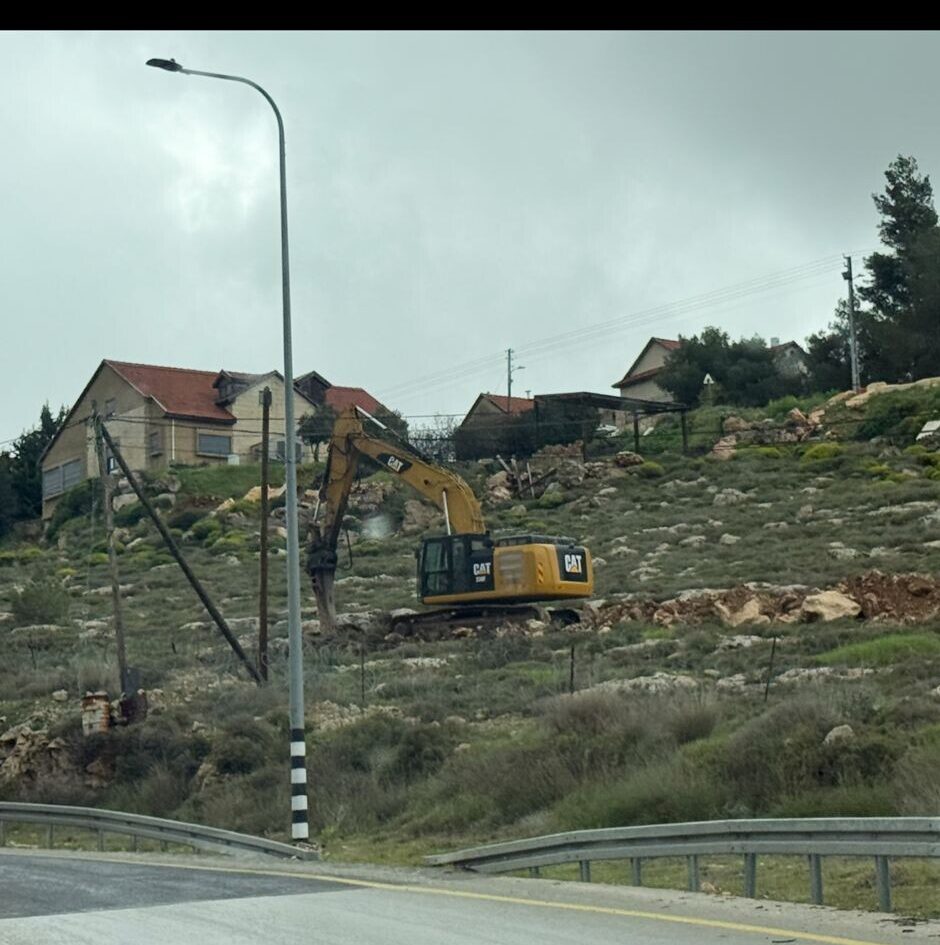 MuhammadFeb-24-2026South Hebron Hill, Beit Hagai: Paving an internal security road
-