
Kfar Giladi's quary in South HebronH ills


At the Meitar crossing, the parking lot is full on both sides of Route 60, including three buses that brought families to visit families. Apparently, family visits are yet not banned as a collective punishment.
We drove on the road to Tene Omarin and Ramadin, west of Road 60. On the way we passed through the quarry of Kfar Giladi which now reaches almost to Dahariya.
You ask: Kfar-Gileadi? How is the kibbutz in the north related to this area of southern Mount Hebron? And so an explanation can be found on Kerem Navot’s website:
It turns out that Kibbutz Kfar Giladi operates the Yatir Quarry here, which belongs to the Kfar Giladi Quarry Company: the occupier is exploiting the Palestinians’ land’s in the occupied territory!
On a very rough road which can hardly be called a road but which is very beautiful, we passed through the village of Shweika. In a normal place, the area would be full of tourists, restaurants and places to eat, but…
The residents of the village suffer greatly from the settlers of Eshtamo’a. The settlers do not let them plough their land, they confiscate the tractors of the Palestinians with the help of the army. The masters of the land , the settlers command the army which does their bidding, and the settlers call in the army and delay the Palestinians until the army arrives.
We went to Abu-Safi, who lives deep in the area, near the Asael outpost. On the way we met Miriam, his 12-year old daughter with the sheep on the hills. She greeted us with shouts of joy that warmed the heart. Since there was a school holiday, all the girls in the family, from the youngest to the oldest, are working, some in the pasture and some in feeding the animals. Abu-Safi himself is sick and hospitalized in the hospital in Dura.
We arrived loaded with packages that Samader had collected, which made the girls very happy, especially the toys and games.
Again we are told about the bullying of Israel Kaplan the illegal settler who
owns the farm near Asael. He throws his dead sheep on the dirt roads of the Palestinian residents, he does not allow them to graze their sheep on their lands and he brings his flock to the pastures they sowed. Everything is his.
A week before our visit, the army arrived and drove out Abu Safi’s neighbour who was in his own pasture.
Two weeks before, many vehicles of the Keren Kayemeth Leyisrael (the Jewish National Fund) arrived to inspect the area. Perhaps in preparation for Tu Bishavat (the 15th of the month Shvat) which is the Jewish holiday of planting trees, looking for new national lands. We will follow to see what happens.
When we said goodbye, all the family came out to see us off.
Dura Al-Fawwar Junction
See all reports for this place-
Junction on Route 60: west - the town of El Dura, east - the Al Fawwar refugee camp. There is a manned pillbox at the junction. From time to time the army sets up flying checkpoints at the entrance to El Fawwar and Al Dura. Al-Fawwar is a large refugee camp (7,000 inhabitants in 2007) established in 1949 to accommodate Palestinian refugees from Be'er Sheva and Beit Jubrin and environs. There are many incidents of stone-throwing. In the vicinity of the pillbox there are excellent agricultural areas, Farmers set up stalls adjacent to the plots close to the road. In recent months the civil administration has set up dirt embankments thereby blocking access to the stalls, and making it impossible for the farmers to sell their vegetables. Updated April 2021, Michal T.
-
Meitar checkpoint / Sansana
See all reports for this place-
Meitar Checkpoint / Sansana The checkpoint is located on the Green Line and serves as a border crossing between Israel and the West Bank. It is managed by the Border Crossing Authority of the Defense Ministry. It is comprised of sections for the transfer of goods as well as a vehicle checkpoint (intended for holders of blue identity cards, foreign nationals or diplomats and international organizations). Passing of Palestinians is prohibited, except for those with entry permits to Israel. Palestinians are permitted to cross on foot only. The crossing has a DCO / DCL / DCL / DCL (District Coordination Office), a customs unit, supervision, and a police unit. In the last year, a breach has been opened in the fence, not far from the crossing. This breach is known to all, including the army. There does not appear to be any interest in blocking it, probably as it permits needed Palestinian workers without the bureaucratic permits to get to work in Israel. Food stalls and a parking area economy have been created, but incidents of violent abuse by border police have also been recorded. Updated April 2022
-
South Hebron Hills
See all reports for this place-
South Hebron Hills
South Hebron Hills is a large area in the West Bank's southern part.
Yatta is a major city in this area: right in the border zone between the fertile region of Hebron and its surroundings and the desert of the Hebron Hills. Yatta has about 64,000 inhabitants.
The surrounding villages are called Masafer Yatta (Yatta's daughter villages). Their inhabitants subsist on livestock and agriculture. Agriculture is possible only in small plots, especially near streams. Most of the area consists of rocky terraces.Since the beginning of the 1980s, many settlements have been established on the agricultural land cultivated by the Palestinians in the South Hebron Hills region: Carmel, Maon, Susia, Masadot Yehuda, Othniel, and more. Since the settlements were established and Palestinians cultivation areas have been reduced; the residents of the South Hebron Hills have been suffering from harassment by the settlers. Attempts to evict and demolish houses have continued, along with withholding water and electricity. The military and police usually refrain from intervening in violent incidents between settlers and Palestinians do not enforce the law when it comes to the investigation of extensive violent Jewish settlers. The harassment in the South Hebron Hills includes attacking and attempting to burn residential tents, harassing dogs, harming herds, and preventing access to pastures.
There are several checkpoints in the South Hebron Hills, on Routes 317 and 60. In most of them, no military presence is apparent, but rather an array of pillboxes monitor the villages. Roadblocks are frequently set up according to the settlers and the army's needs. These are located at the Zif Junction, the Dura-al Fawwar crossing, and the Sheep Junction at the southern entrance to Hebron.
Updated April 2022
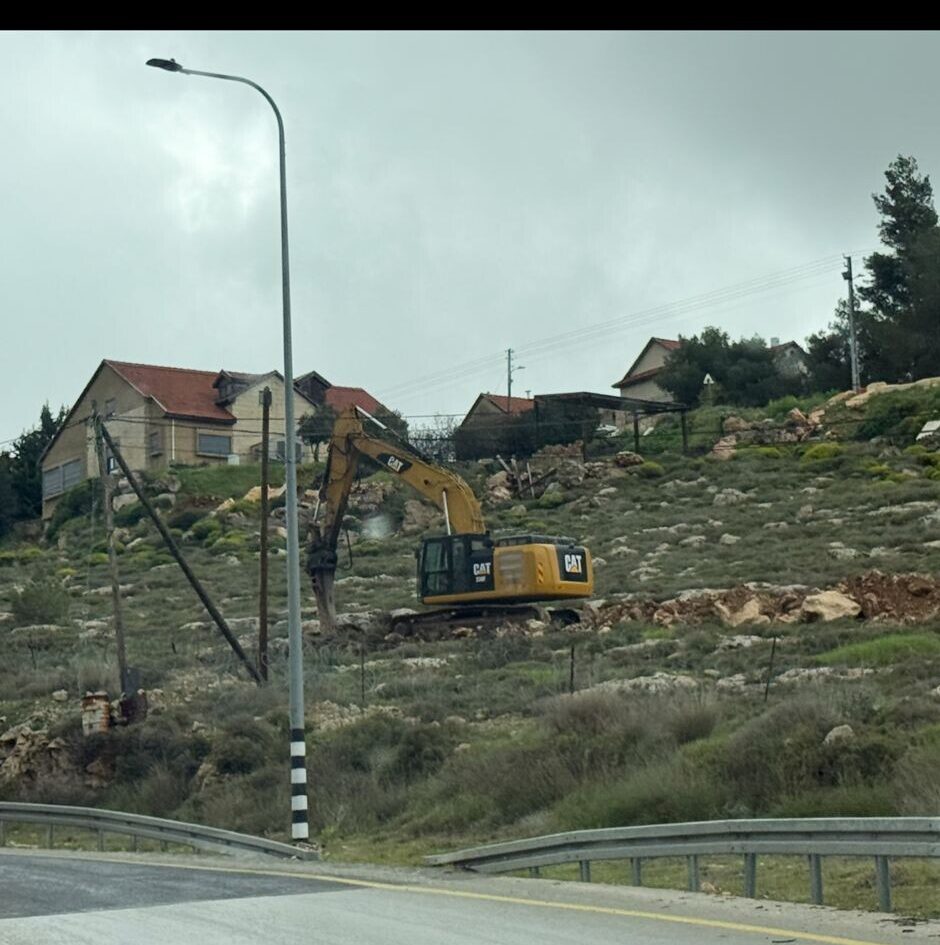 MuhammadFeb-24-2026South Hebron Hill, Beit Hagai: Paving an internal security road
-