
Dura-Al Fawwar Junction, Hebron, South Hebron Hills

While in the Negev there is a struggle of the Bedouin trying to sow and plant on their own lands, in the areas of the southern Hebron Hills, the struggle has already been decided – settler farms that plant vineyards and build pens for the flocks of sheep emerge like mushrooms after the rain.
Opposite Zanuta we noticed a hill with a number of new metal structures on it, and on the slope below it, a beautifully planted vineyard.
On the western side of the road in front of Eshtamoa, a shed has appeared and next to it a truck with a transportable structure on it – the beginning of an agricultural outpost.
Hebron – fenced and surrounded.
We walked along the Road of the Worshipers towards the Cave of the Patriarchs. The area of the ancient houses is constantly being renewed, with the support of various Arab countries (there are signs on the houses) which are being renovated to glorify Hebron. A beautiful example of sustainable construction – stones that have fallen from the old houses are used and added to parts that still have a strong and solid structure.
The path ends with nothing – it turned out that another fence was built around the cave, which runs along the slope and continues almost to checkpoint 160. Between the two fences – the old one, which surrounded only the cave, and the new one, the road which connected the worshipers to the main road south of the cave. The fence almost touches the houses of the old neighborhood and they have no choice but to struggle through the mud at the edges of the houses and to take a long way to way to the edge of the yellow fence. We tried the experience, not recommended. – Attached picture
Behind the boys’ school, near the wholesale market, Nahal soldiers attacked us in an attempt to prevent us from entering Shuhada Street. They claimed that only the residents of the neighborhood were allowed. We objected to the ban, we only agreed to present ID cards. They tried to connect with the commander but it was Ofer Ohana who was happy to see us and explained to the new soldiers that we were the friends of the Palestinians. That helped. (Jews can walk anywhere but some Jews are more Jewish than others it seems. Ofer Ohana is an enemy of anyone on the left and it can only be left to the imagination as to how he described the women)
On the way back down from Shuhada Street, up the stairs to Cordoba School, an elderly Palestinian woman was detained on the grounds that her name did not appear on the list of families living on the hill who are allowed to cross the locked gate and up the stairs. The daughter did not appear on the list and the soldier insisted on not opening the gate for her.
While we waited, a group of students with scull caps appeared and teachers accompanied them. They were engaged in a field study mission and naturally asked to ascend through the same gate. The soldier claimed that they could not ascent , (apparently there are dangerous animals in the area) and thus forced both the older Palestinian and the rejoicing children to extend their journey with the steep ascent.
Hard city Hebron!
On the way back we were happy to see that the Dura-El Fawwar Junction is back to life, the fields are full with produce and the farmers are picking and selling straight to anyone who is interested. Fresh and fragrant goods.
Dura Al-Fawwar Junction
See all reports for this place-
Junction on Route 60: west - the town of El Dura, east - the Al Fawwar refugee camp. There is a manned pillbox at the junction. From time to time the army sets up flying checkpoints at the entrance to El Fawwar and Al Dura. Al-Fawwar is a large refugee camp (7,000 inhabitants in 2007) established in 1949 to accommodate Palestinian refugees from Be'er Sheva and Beit Jubrin and environs. There are many incidents of stone-throwing. In the vicinity of the pillbox there are excellent agricultural areas, Farmers set up stalls adjacent to the plots close to the road. In recent months the civil administration has set up dirt embankments thereby blocking access to the stalls, and making it impossible for the farmers to sell their vegetables. Updated April 2021, Michal T.
-
Hebron
See all reports for this place-
According to Wye Plantation Accords (1997), Hebron is divided in two: H1 is under Palestinian Authority control, H2 is under Israeli control. In Hebron there are 170,000 Palestinian citizens, 60,000 of them in H2. Between the two areas are permanent checkpoints, manned at all hours, preventing Palestinian movement between them and controlling passage of permit holders such as teachers and schoolchildren. Some 800 Jews live in Avraham Avinu Quarter and Tel Rumeida, on Givat HaAvot and in the wholesale market.
Checkpoints observed in H2:
- Bet Hameriva CP- manned with a pillbox
- Kapisha quarter CP (the northern side of Zion axis) - manned with a pillbox
- The 160 turn CP (the southern side of Zion axis) - manned with a pillbox
- Avraham Avinu quarter - watch station
- The pharmacy CP - checking inside a caravan with a magnometer
- Tarpat (1929) CP - checking inside a caravan with a magnometer
- Tel Rumeida CP - guarding station
- Beit Hadassah CP - guarding station
Three checkpoints around the Tomb of the Patriarchs
 Raya YeorDec-18-2025Hebron - Yusri Jaber and part of his family
-
South Hebron Hills
See all reports for this place-
South Hebron Hills
South Hebron Hills is a large area in the West Bank's southern part.
Yatta is a major city in this area: right in the border zone between the fertile region of Hebron and its surroundings and the desert of the Hebron Hills. Yatta has about 64,000 inhabitants.
The surrounding villages are called Masafer Yatta (Yatta's daughter villages). Their inhabitants subsist on livestock and agriculture. Agriculture is possible only in small plots, especially near streams. Most of the area consists of rocky terraces.Since the beginning of the 1980s, many settlements have been established on the agricultural land cultivated by the Palestinians in the South Hebron Hills region: Carmel, Maon, Susia, Masadot Yehuda, Othniel, and more. Since the settlements were established and Palestinians cultivation areas have been reduced; the residents of the South Hebron Hills have been suffering from harassment by the settlers. Attempts to evict and demolish houses have continued, along with withholding water and electricity. The military and police usually refrain from intervening in violent incidents between settlers and Palestinians do not enforce the law when it comes to the investigation of extensive violent Jewish settlers. The harassment in the South Hebron Hills includes attacking and attempting to burn residential tents, harassing dogs, harming herds, and preventing access to pastures.
There are several checkpoints in the South Hebron Hills, on Routes 317 and 60. In most of them, no military presence is apparent, but rather an array of pillboxes monitor the villages. Roadblocks are frequently set up according to the settlers and the army's needs. These are located at the Zif Junction, the Dura-al Fawwar crossing, and the Sheep Junction at the southern entrance to Hebron.
Updated April 2022
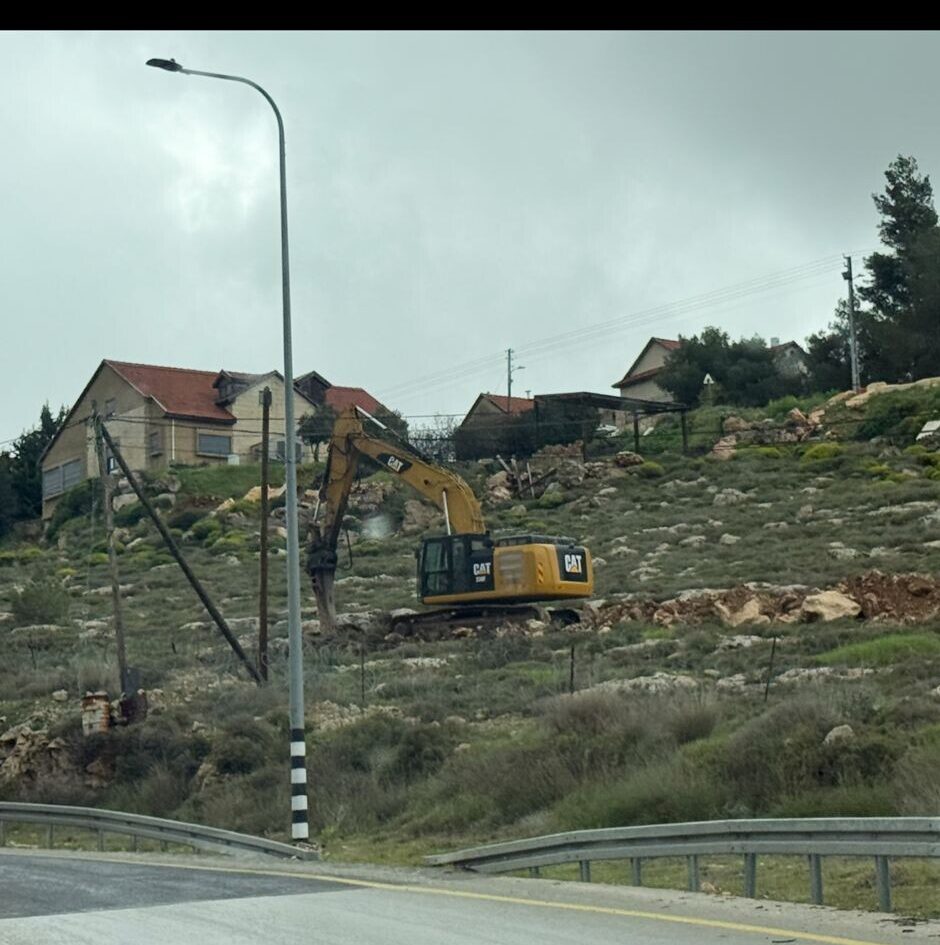 MuhammadFeb-24-2026South Hebron Hill, Beit Hagai: Paving an internal security road
-