
Qalandiya - The gate designated for wheelchairs would not open
At Qalandiya Checkpoint time is not a permanent value.
At Qalandiya Checkpoint freedom is not a permanent value.
At Qalandiya Checkpoint personal space is not a permanent value.
At Qalandiya Checkpoint, time, freedom and personal space depend on official procedures, orders and whim.
Because ill patients from Gaza returning home after treatment and hospitalization in the West Bank or East Jerusalem are familiar with how this place operates they arrive at the DCO offices as early as they can, deposit their documents with the Civil Administration representatives and wait until the afternoon, until they are permitted to exit and go home.
The ill and disabled sit for long hours waiting, without having any food. A kind of imposed quarantine.
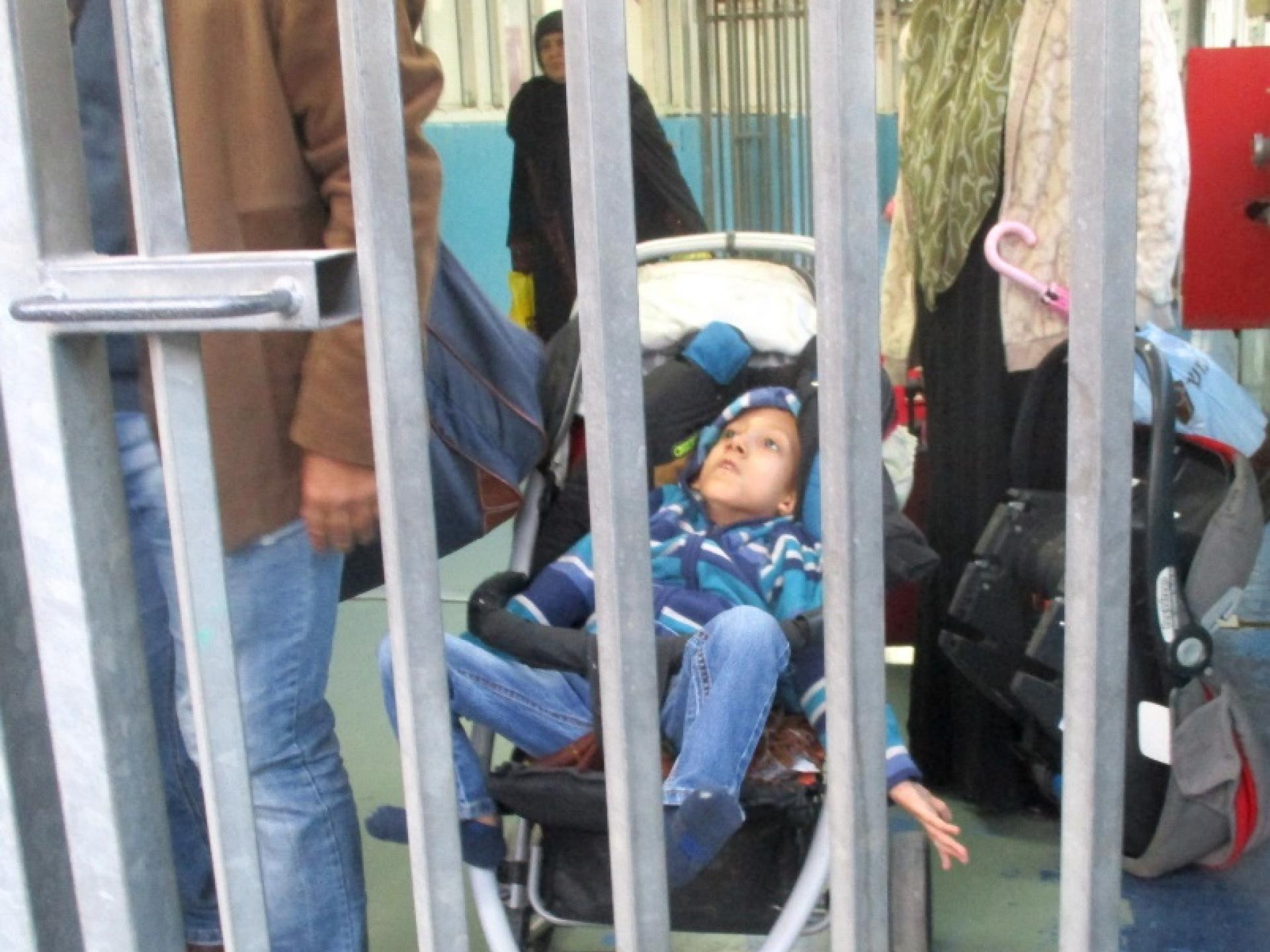
On this day, only at 4:30 PM did a Civil Administration official lead the group of those returning to Gaza outside the checkpoint compound, but the gate designated for wheelchairs would not open. “It’s been out of order for two weeks now”, said one who knew.
A father got stuck there while leading his child – who suffers from cerebral palsy – in a pram because they have no money for a wheelchair nor for medication. An elderly woman in a wheelchair got stuck there too, as did a man moving with a walker.
Repeated attempts to open the locked gate did not succeed and the delay was lifted only when the Civil Administration person came to his senses and led the movement impaired patients by another route.
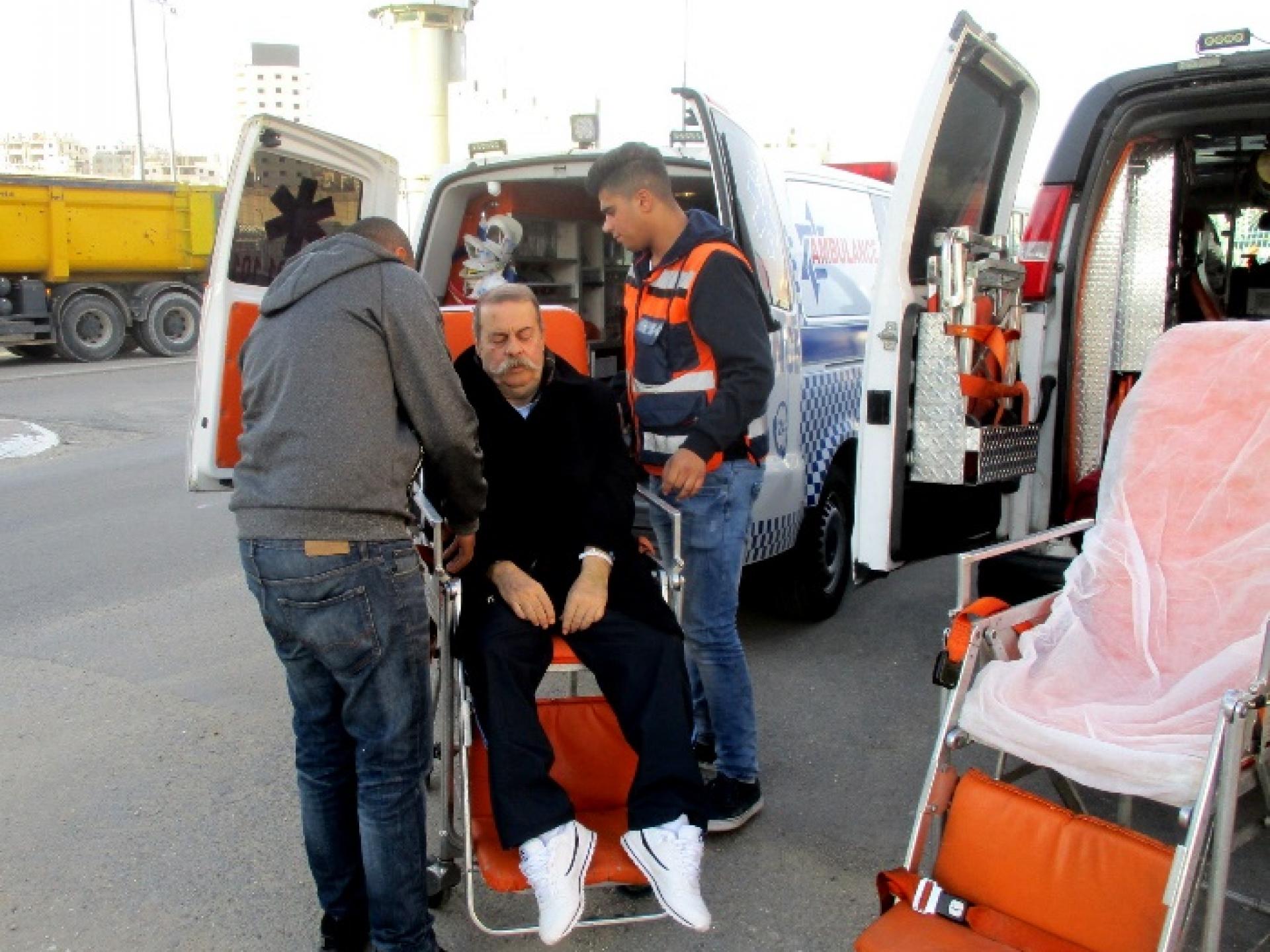
During the hour and a half I waited for the patients to arrive, two back-to-back procedures took place: because of “renovations” the space where patients from the West Bank to Jerusalem and back were transferred from one ambulance to another, for months now both ambulances must maneuver in order to arrive and face each other between the two traffic lanes at the center of the vehicle checkpoint, a place where pedestrians (such as I) are strictly forbidden to reach. But on that day the team operating the vehicle checkpoint was fairly people-friendly and I managed to come in contact and talk with the medical teams.
- A man was transported from Jerusalem to Ramallah after undergoing abdominal surgery. The post-surgery treatment and recovery will take place in a Ramallah hospital, where he will be visited by his family, un-prevented from staying by him as he and they please.
- A man who suffered a cardiac attack was transported from Ramallah to Jerusalem, connected to oxygen and accompanied by a physician. “He also has brain cancer”, said the ambulance driver. At Muqassad Hospital (East Jerusalem) he will be treated, perhaps his condition will improve, but what about his isolation and distance from his family there?
Qalandiya Checkpoint / Atarot Pass (Jerusalem)
See all reports for this place-
Click here to watch a video from Qalandiya checkpoint up to mid 2019 Three kilometers south of Ramallah, in the heart of Palestinian population. Integrates into "Jerusalem Envelope" as part of Wall that separates between northern suburbs that were annexed to Jerusalem in 1967: Kafr Aqab, Semiramis and Qalandiya, and the villages of Ar-Ram and Bir Nabala, also north of Jerusalem, and the city itself. Some residents of Kafr Aqab, Semiramis and Qalandiya have Jerusalem ID cards. A terminal operated by Israel Police has functioned since early 2006. As of August 2006, northbound pedestrians are not checked. Southbound Palestinians must carry Jerusalem IDs; holders of Palestinian Authority IDs cannot pass without special permits. Vehicular traffic from Ramallah to other West Bank areas runs to the north of Qalandiya. In February 2019, the new facility of the checkpoint was inaugurated aiming to make it like a "border crossing". The bars and barbed wire fences were replaced with walls of perforated metal panels. The check is now performed at multiple stations for face recognition and the transfer of an e-card. The rate of passage has improved and its density has generally decreased, but lack of manpower and malfunctions cause periods of stress. The development and paving of the roads has not yet been completed, the traffic of cars and pedestrians is dangerous, and t the entire vicinity of the checkpoint is filthy. In 2020 a huge pedestrian bridge was built over the vehicle crossing with severe mobility restrictions (steep stairs, long and winding route). The pedestrian access from public transport to the checkpoint from the north (Ramallah direction) is unclear, and there have been cases of people, especially people with disabilities, who accidentally reached the vehicle crossing and were shot by the soldiers at the checkpoint. In the summer of 2021, work began on a new, sunken entrance road from Qalandiya that will lead directly to Road 443 towards Jerusalem and Tel Aviv. At the same time, the runways of the old Atarot airport were demolished and infrastructure was prepared for a large bus terminal. (updated October 2021)
 Tamar FleishmanFeb-27-2026Qalandiya: On the way to prayer
-