Our goal was to learn about the Set Za’hara maqam and visit the villages that had a direct connection to it before it was demolished: Deir J’rir and Kafr Maliq. The settlement of Kochav Hashachar and the Mitzpe Kramim outpost have been established on their lands. Regarding the outpost – the District Court recently determined that it can be recognized legally as a settlement even though it was built on privately owned land belonging to Palestinians. We also wanted to visit the Sheikh ‘Amar maqam, located in Deir Dibuan.
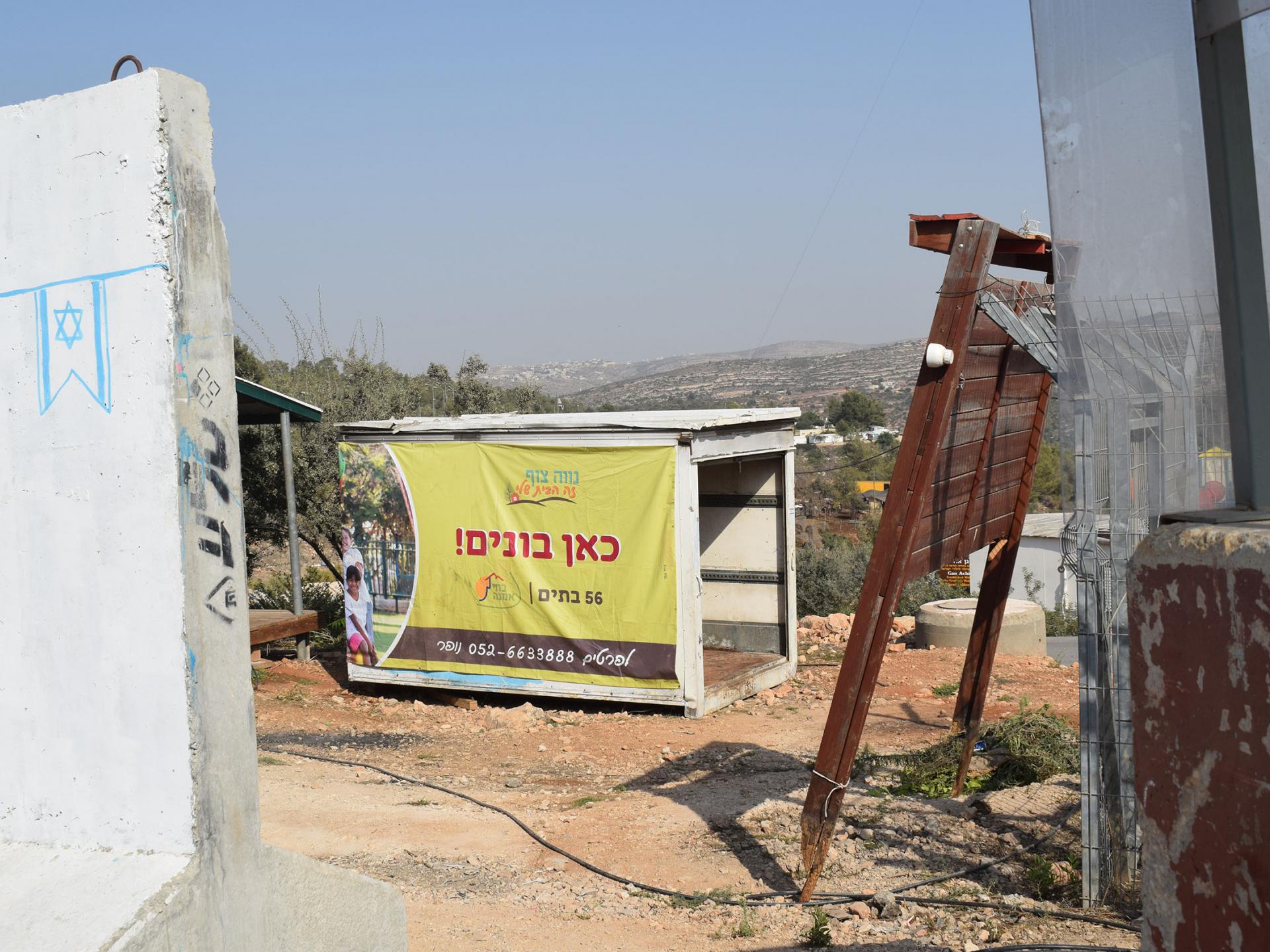
We arrived at its location, at the foot of the hill. A large sign announces “Mitzpe Rehav’am” and “Har Kochav” (there’s no mention of the maqam, of course). A deserted and neglected industrial zone with a few locked prefabs is located on the outskirts of the Kochav Hashachar settlement. Nearby we’re greeted by a large sign, “Ginot Matanya – Our home between the garden and the vineyard.” This area is also deserted; perhaps it’s a recreation area for Kochav Hashachar residents.
We continued to the Rimonim settlement, a hilltop community east of the Alon Road on the other side of Kochav Hashachar. Lovely homes and flourishing gardens. The Mitzpeh Eli settlement is on a hill, antennas overseeing the area, and an archaeological site called Khirbet al Kilia. The sign explains that a Roman road once passed through here, secured by guard posts and watchtowers. Finds at the site were dated to the Byzantine, Umayyad and Abbasid periods. According to the sign, “…The site was inhabited for about 500 years, and at present by the inhabitants of Rimonim…” True historical continuity.
We continued in the direction of Ramallah and passed Tayibe village on Highway 449, east of the Ofra settlement, and reach our first destination.
Deir J’rir
We met the head of the village at the municipal building; he welcomed us. He’s been here only since 2000 so he couldn’t answer many of our questions. He said the Kochav Hashachar settlement stole 25 dunums of their land. Before he arrived the villagers had spent a lot of money for a lawyer to object, but to no avail. We asked when the maqam had been demolished, and whether he could tell us anything about it and its connection to the village. But it had already been demolished when he came to the village. He says the army demolished it. And, in fact, on our previous visit here it appeared that heavy equipment was used for the demolition, which supports his claim. We asked about their relationships with the settlers. He said shepherds aren’t allowed to come near the settlement and three months ago their entire grazing area was set afire. He also complained on behalf of workers who are delayed at checkpoints, especially the one near Ofra. An additional council member joined us and wanted to know whether we’d coordinated our visit with the Palestinian liaison office (DCO). It turned out that about two months earlier the Palestinian Authority announced that every visit or meeting with Authority officials, including, of course, municipal officials, requires advance coordination via the DCO. We asked to see the text of the order. The head of the municipality showed it to us and was even willing to photocopy it at our request but the council member announced firmly that it was impossible to do so. And thus our visit concluded. Given the change in attitude toward us, we decided not to visit the Kafr Maliq municipality, in order first to find a different liaison person. Before having to leave we asked the head of the municipality to try and find for us someone who knows the history of the maqam and can tell us about it. He promised to do so.
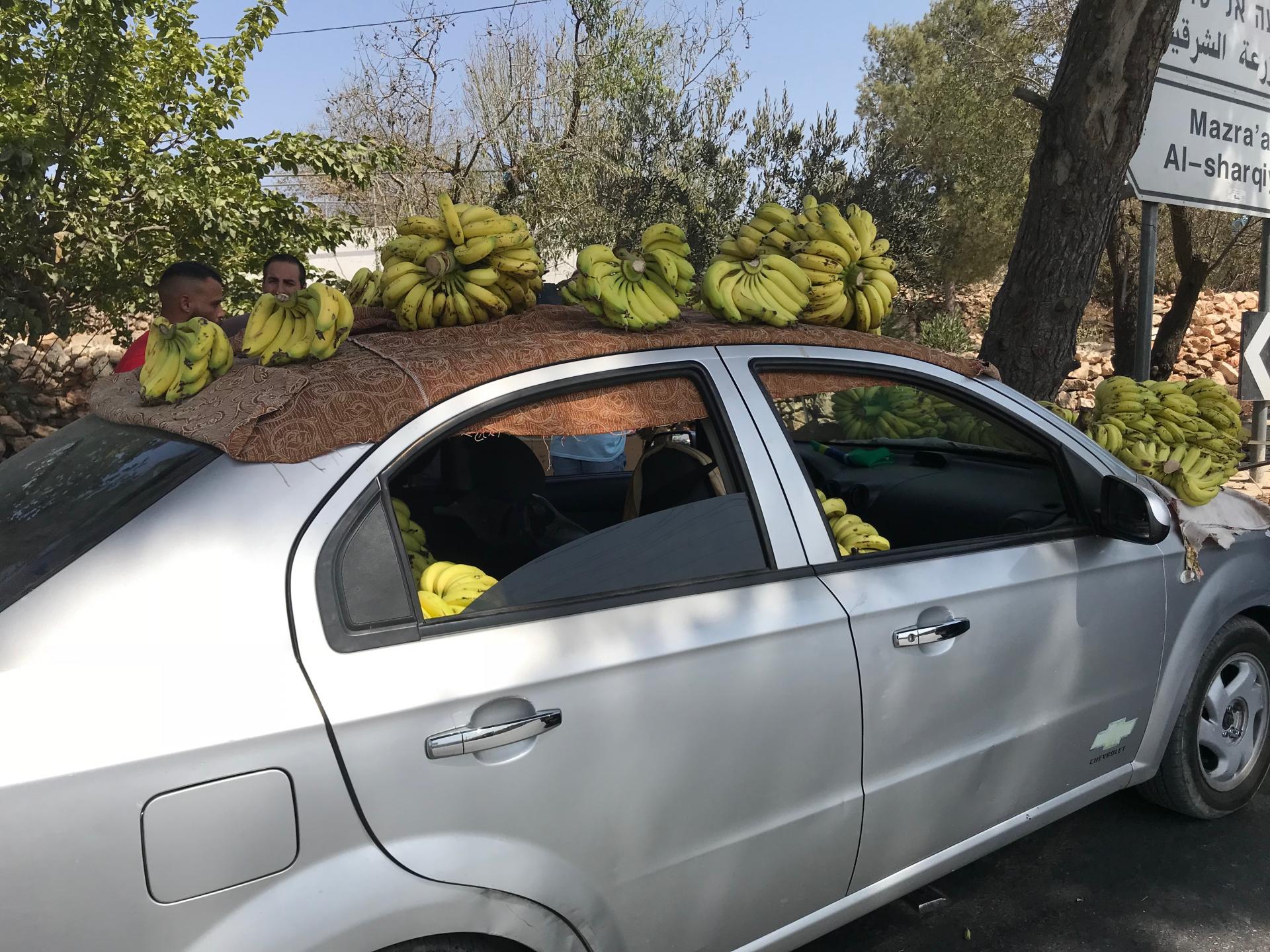
Leaving Deir J’rir we saw along the road many attractive field huts built from the same stones used for the terraces. When we reached the Mazra’a al Sharquiya junction we saw a car loaded with bananas on the side of the road. We stopped to buy some and talk with the seller. He buys bananas in the Jericho area and sells them from his car. Do you make a living, we asked? Praise God, he said (NIS 10 for two kilos), he has no complaints. Bananas grow in the area all year, but as you know there are water shortages there and many farmers have given up. One of the large growers in the area had to stop and opened a building materials store, but what will the now-unemployed workers do?
Another story, between Silwad and Yabrud. The army sets up checkpoints almost every day for three to six hours, which makes life very difficult for the inhabitants.
Ten days ago the police came to him (he emphasized they weren’t soldiers but people in Israeli police uniforms) and demanded the keys to his car. He said he didn’t have them and they Tased him and left. Since then they’ve been coming two or three times a week but they ignored him.
We continued on Highway 60. On the left we pass the fence around Ofra; behind it, the settlement looks like a giant prison. We passed Bitin and reached Deir Dibuan, our final destination.
Deir Dibuan
A wealthy village, magnificent homes, flourishing gardens. Many of the residents are foreign citizens, primarily Americans. This is one of the few locations whose residents had expropriated land returned to them because of the owners’ American citizenship.
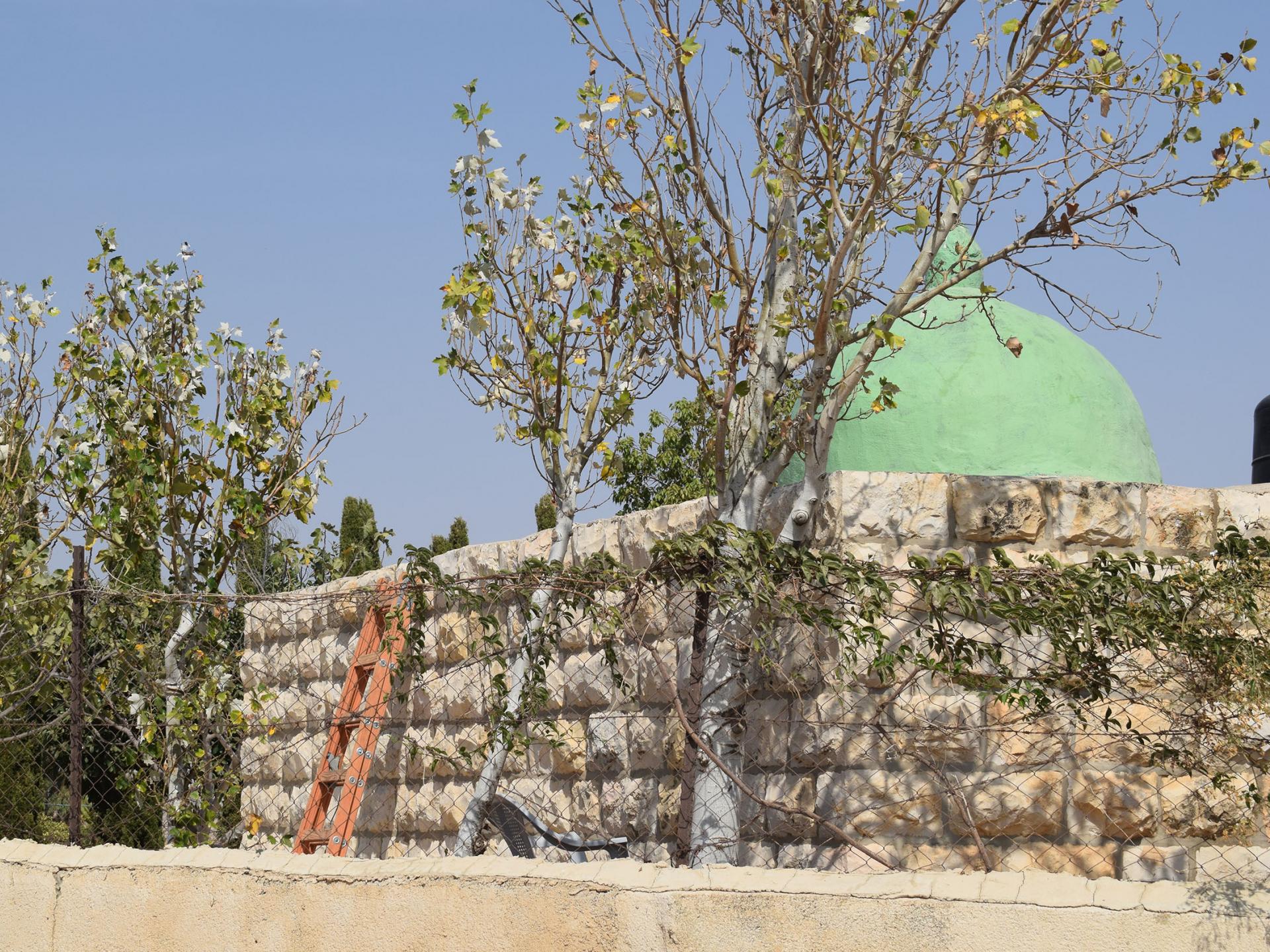
The maqam itself is located outside the village. It’s the only maqam we saw that still fulfills its original function and combines a site for prayer and spirituality with a center of community life. The maqam has been renovated and contains attractive, colorful prayer rugs. Surrounding the building are playgrounds for children and a lovely garden with benches and tables. Here too, unfortunately, the water shortage is evident – the trees are drying out. It’s interesting to note that the people who directed us to the location all knew it was called Sheikh ‘Amar, but the sign says “Ilbayara,” which means “citrus grove.” In other words, the community’s leisure activities are fully consistent with the sanctity of the location as a place for prayer, and denial of access to maqams or demolishing them damages the fabric of the community.
An additional stop on our way back:
The Neve Tzuf, or Umm Safa forest, a nature preserve which is partly natural forest and partly on the land of Nabi Salah. The preserve includes olive groves belong to Nabi Salah. We saw the trees have no fruit even though the season has begun, and the groves appear abandoned and neglected. The regulations governing the nature preserve don’t permit the owners of the grove to plant new trees, and the water shortage also causes serious damage to the farmers.
Halamish junction (Highways 450/465). A checkpoint. The synagogue erected by the settlers of Halamish/Neve Tzuf still stands. Graffiti on the nearby bus stop: Death to Arabs. The settlers don’t cease their attempts to connect Neve Achi and Neve Tzuf, which are divided by the road to Beit Yallu and Deir Nizam.
According to the soldier at the checkpoint, there are occasional disturbances but the army’s job is to restrain the settlers and allow the Palestinians to reach their homes (it appears the Messiah has arrived…). He says there are two synagogues in the settlement, but the settlers erected the one at the junction just to display their presence. He was polite and allowed us to photograph.
On the other side of the road, hidden by the wall, construction continues at the settlement a sign calls Neve Tzuf.