
South Hebron
South Hebron Hills Monday, 3/4/06, AMObservers: Michal Z., Yael Z6.45 – We started our way on a cold and foggy morning, heading straight to Hebron.Sansana – No cars or workers were seen, we passed smoothly.Dura El Pawar – Both gates are open and cars seen crossing the road from both sides. No military presence on the road.Sheep J. – Small line of pedestrians, mostly children, were crossing the road towards Hebron.Shuch- Sair – Few people on their way to Hebron.The roads are almost empty.HebronOur driver took us up to Tarpat CP and went back to park near the Patriarchs Cave. The school children were passing through the magnometer silently while the women were allowed to pass from the gate while their documents were checked.A pair of peace volunteers watching the CP told us that everything was quite and sleepy today.On the way up to Tel Rumaida a bulldozer driven by a soldier escorted by a hummer passed us. We heard the bulldozer working on the hill top at the Palestinian side. As we couldn’t reach the site, although no soldier was seen watching the entrance to the H1 zone, we tried to get information from Palestinians workers on the way. They considered the work as a routine, couldn’t see anything special.Tel Rumaida – We weren’t stopped by the soldiers, the place seemed deserted from both – settlers and soldiers so we went down.Pharmacy CP – was empty.Route 317Zif CP – The gate was open and one car was seen passing.Carmel – A police car was parking facing the junction, escorting the people waiting for a lift.Road constructions were watched 2 km north of Yatir. Who needs a wider road when it always so empty??
Hebron
See all reports for this place-
According to Wye Plantation Accords (1997), Hebron is divided in two: H1 is under Palestinian Authority control, H2 is under Israeli control. In Hebron there are 170,000 Palestinian citizens, 60,000 of them in H2. Between the two areas are permanent checkpoints, manned at all hours, preventing Palestinian movement between them and controlling passage of permit holders such as teachers and schoolchildren. Some 800 Jews live in Avraham Avinu Quarter and Tel Rumeida, on Givat HaAvot and in the wholesale market.
Checkpoints observed in H2:
- Bet Hameriva CP- manned with a pillbox
- Kapisha quarter CP (the northern side of Zion axis) - manned with a pillbox
- The 160 turn CP (the southern side of Zion axis) - manned with a pillbox
- Avraham Avinu quarter - watch station
- The pharmacy CP - checking inside a caravan with a magnometer
- Tarpat (1929) CP - checking inside a caravan with a magnometer
- Tel Rumeida CP - guarding station
- Beit Hadassah CP - guarding station
Three checkpoints around the Tomb of the Patriarchs
 Raya YeorDec-18-2025Hebron - Yusri Jaber and part of his family
-
South Hebron Hills
See all reports for this place-
South Hebron Hills
South Hebron Hills is a large area in the West Bank's southern part.
Yatta is a major city in this area: right in the border zone between the fertile region of Hebron and its surroundings and the desert of the Hebron Hills. Yatta has about 64,000 inhabitants.
The surrounding villages are called Masafer Yatta (Yatta's daughter villages). Their inhabitants subsist on livestock and agriculture. Agriculture is possible only in small plots, especially near streams. Most of the area consists of rocky terraces.Since the beginning of the 1980s, many settlements have been established on the agricultural land cultivated by the Palestinians in the South Hebron Hills region: Carmel, Maon, Susia, Masadot Yehuda, Othniel, and more. Since the settlements were established and Palestinians cultivation areas have been reduced; the residents of the South Hebron Hills have been suffering from harassment by the settlers. Attempts to evict and demolish houses have continued, along with withholding water and electricity. The military and police usually refrain from intervening in violent incidents between settlers and Palestinians do not enforce the law when it comes to the investigation of extensive violent Jewish settlers. The harassment in the South Hebron Hills includes attacking and attempting to burn residential tents, harassing dogs, harming herds, and preventing access to pastures.
There are several checkpoints in the South Hebron Hills, on Routes 317 and 60. In most of them, no military presence is apparent, but rather an array of pillboxes monitor the villages. Roadblocks are frequently set up according to the settlers and the army's needs. These are located at the Zif Junction, the Dura-al Fawwar crossing, and the Sheep Junction at the southern entrance to Hebron.
Updated April 2022
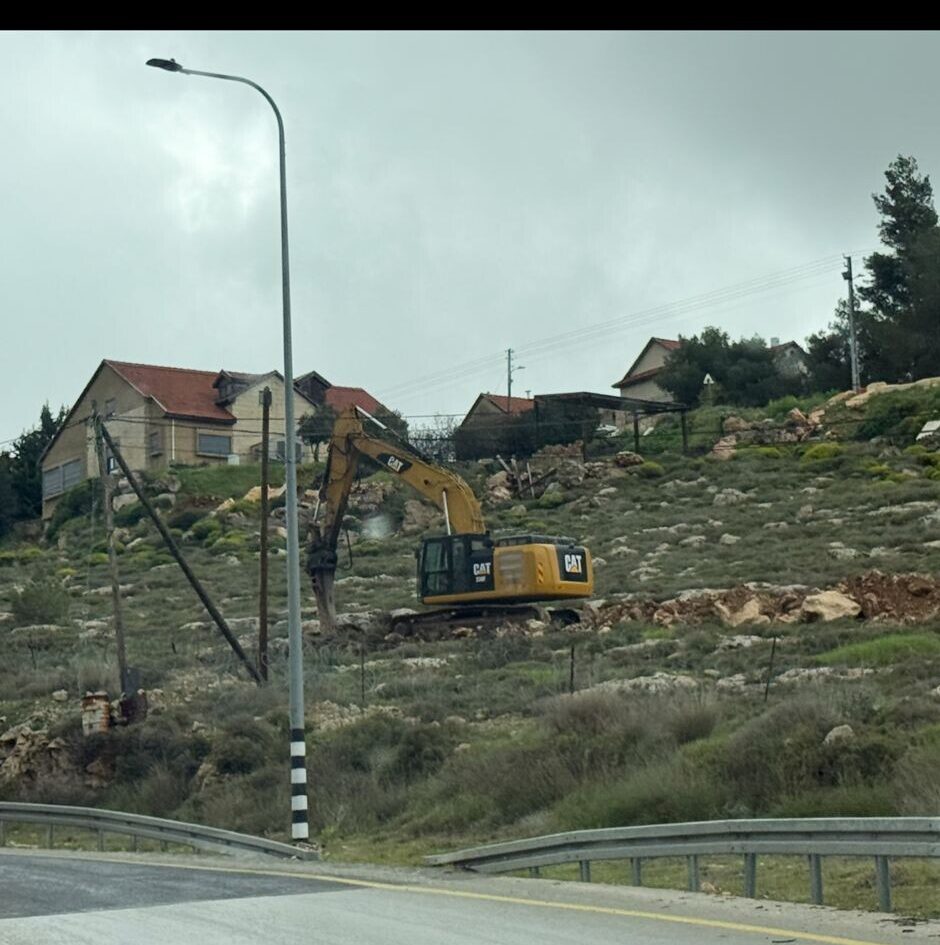 MuhammadFeb-24-2026South Hebron Hill, Beit Hagai: Paving an internal security road
-