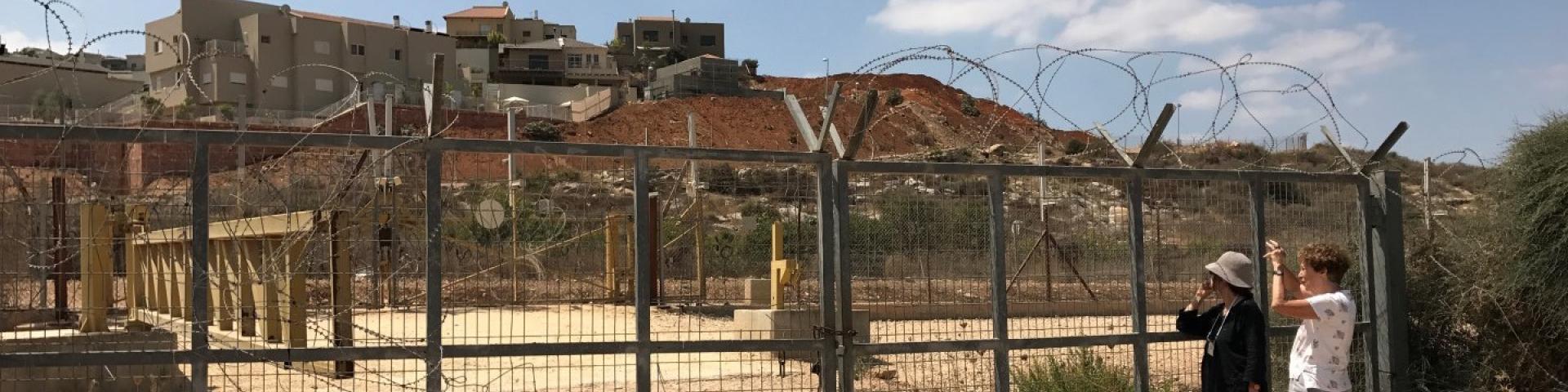
Jayyus

13/04/2013 ,Morning
Nurit Popper, Dalia Golomb (reporting)

Translator:  Charles K.


There were 42 participants and two guides (50 had registered; 8 cancelled prior to the tour).


We covered the “classic loop”: Highway 55 from Qalqilya, Highway 60 to Huwwara,  Highway 5 to Elkana.


Areas included:

The Alfei Menashe seam zone, including the Habla gate checkpoint and the view from Alfei Menashe / Jayyus / Qadum / Huwwara checkpoint / Huwwara village / the Elkana seam zone including the Azzun Atma checkpoint and Hani’s home.


The tour left Tel Aviv at 11.15 and ended at 18.30.


We stopped on the Green Line near Qalqiliya, on the bridge over Highway 6.  From there, near Alfei Menashe, we observed the fence blocking the villages of Ras a-Tira and Wadi Rasha from accessing their lands.  We then continued to the Habla checkpoint / agricultural gate.


Although we arrived at the Habla checkpoint during the hours it was to have been open, we weren’t able to see it in operation.  It was locked because the army hadn’t come to open it.  We telephoned the DCO, who told us they were aware of the delay.  Don’t worry, the soldiers will arrive.  When?  Not clear.  We waited 20 minutes and left.  And thus we experienced what happens to Palestinians at this supposed crossing.


Meetings with Palestinians:

We weren’t able to meet with Umar at the plant nursery in the seam zone (at the Habla gate) because it was Saturday.  But the meeting with Na’im in Jayyus made a very strong impression, primarily because of his personality and the way he presented the information, “spiced” with personal and family stories, and in fluent Hebrew.  He accompanied us along the fence and we saw his lands on the other side.  We heard about arrests of youths at night, about intimidation and fear, about those blacklisted by the Shabak and the yearning for peace.


The meeting with Sakkar at Qadum was important in order to become acquainted with the fact that although the locality has no fence, he’s prevented from reaching his lands (there’s a virtual fence: starting at a particular post…).   He’s also prevented by a checkpoint from reaching Nablus via the shortest route, which he used to take long ago.  Because the settlement of Quedumim doesn’t want them nearby, a checkpoint was established (security).

We walked with Sakkar along the route the inhabitants take during their demonstrations – from the village center to that same post beyond which they know they’re not allowed to proceed.  The path is black from tires burned by the residents during every demonstration in order to prevent the army from entering the village.

Even though the demonstration is non-violent the army fires tear gas and sprays stinking liquid at them, and sometimes employs dogs.  That’s the ritual that’s been repeated every Friday after prayers for two years.  Like at Bil’in.


We saw the Palestinian villages along Highway 60 (Asira Qabaliya, Madama and Burin), above whom, on the hills on both sides of the road, are the violent settlements that harass them and their olive groves – Gil’ad Farm, Beracha and Yitzhar (some say the area lives “between a blessing [Beracha] and a curse.”)


We didn’t stay at the Huwwara checkpoint because time was short.  We only observed the empty terminal from the bus.  A monument to the checkpoint which pointlessly tortured people for six years.  Soldiers tried to move us away but we didn’t react because we hadn’t intended to stay in any case.  The view from the bus, along with the stories, was enough.


Participants in the tour were amazed by the atmosphere in the village of Huwwara – as if the “conflict” never existed.  Everyone was calm.  Welcoming us, as is traditional among Palestinians.  Falafel, coffee, and – as noted – the overall atmosphere made their effect felt.  It’s an experience not to be missed.


We crossed through the Shomron crossing checkpoint without inspection.


And ”last but not least” – the Elkana seam zone:

The Azzun Atma checkpoint and Hani’s besieged home- the entire occupation in a nutshell.


Summary of the feedback we received:


Of the 42 participants (including two friends of ours who came with their families), we received the following responses to questions:


12 were interested in obtaining material from us

15 men and women expressed interest in joining us

15 didn’t respond


How did you hear about the tour?

16 – the ad in Ha’aretz

1 – the internet

10 – from friends (some of them via Ha’aretz)

1 – Psycho Active

Only 3 (unfortunately) from Machsom Watch members


From the feedback we received via email:

Thanks to Dalya for guiding this fascinating and very important tour.

Many Israelis should take a tour like this.

As I always say – Machsom Watch women are the country’s eyes.

Thank you, and best wishes

Buma Inbar  054-767 0511


And from the previous tour on 27.3 with the “Meretz” forum against the occupation


Dear Dalya:

Thank you for the tour and your patient, professional guidance.  Many of the participants told me they’d learned much that was new, and some included information from the tour and their praises on Facebook.

Musi Raz.


Thank you for yesterday’s excellent tour.  Even for those participants well-acquainted with the political reality of Israel that life here has inured us to, and who are seemingly very familiar with the praxis of separation and the unbearable regime under which Palestinians in the occupied territories live, the tour was a must.


The tour was excellently planned and carried out.  The wonderful and accurate tour leadership allowed participants to learn about the various complex issues which the Palestinians confront.  Despite the feelings of anger and frustration accompanying a tour like this, we are proud of Machsom Watch, of its worthy activities on behalf of the Palestinians,but which are also on behalf of our own society.

C.L.


30/01/2013 ,Afternoon
Dani B. (guest) Na'ava M., Karin L. (reporting)

Translator:  Charles K.


Our guest is a young theater person from the US travelling around Israel and the West Bank to record people and collect material for a play.  As we cross the bridge over Highway 6 I point out the location of the Green Line, the 1967 border.  A few hundred yards farther on we reach the turn to the Habla checkpoint, an agricultural gate open three times a week.  What’s most annoying these days to people cultivating their land beyond the fence is that the gate opens very late in the afternoon when it’s already dark, and they’re forced to wait a long time after they’ve finished working in order to return home to Habla and Qalqilya.


12:45  Habla.  While waiting for the gate to open, A. explains that all the surrounding lands belong to residents of Qalqilya and Azzun who must get special permits which are hard to obtainin order to reach their land.  The separation fence has been built on part of their land, robbing them of a large area because it requires a strip 40-60 meters wide that cuts them off from their holdings.  He mentions the village of A-Tira which had been in the Alfei Menashe enclave until the High Court ordered the fence route changed so it now adjoins their homes, cutting them off from some of their land.  He believes both peoples have a right to their own country, but they also have the right not to be divided from one another.


13:00  Soldiers came to open the checkpoint.  A woman from Habla and two young men from Qalqilya are waiting.  One of the latter speaks a little Hebrew, explaining he works in the plant nurseries, arrives at 8 each morning, goes home in the afternoon.  He earns NIS 70 a day, pays NIS 20 for transportation and NIS 10 for lunch, leaving him with NIS 40.  He has no choice; even NIS 40 is more than he could earn in Qalqilya.

Little traffic in each direction, apparently because of the rain.


13:30  We continued toward Alfei Menashe; we showed our guest the new fence mentioned above that had been built so that Ras a-Tira would be located on the other side, and the big gates through which the villagers were supposed to cross, but they’re always shut (except, possibly, for a few days during the olive harvest season).  Then, after briefly driving through Alfei Menashe, we reached Arab a-Ramadinto see whether the school is still standing.  We saw the start of new construction, in addition to the three classrooms and teachers’ room.  Because of the rain there was no one we could ask whether it was still in danger of being demolished.


14:00  Eliyahu checkpoint.  No cars detained.  They explained that the reason the checkpoint was placed here, a few kilometers from the border, was to take over Palestinian land and to make the residents of Alfei Menashe feel they’re in Israel.

Azzun:  We visited Z., who was very glad for all we brought and was willing to be interviewed and tell his story.  He had been strong and healthy and worked in construction until he was caught by the police without a permit to work in Israel; they beat him badly in the head and everywhere on his body even though he asked them to stop, that he’s not guilty of anything other than the need to work and support his wife and children.  He was jailed for four months and despite his complaints wasn’t permitted to see a doctor.  Since his released he’s been suffering from neurological problems that have prevented him from working.  He’s been examined many times in Palestinian and Israeli hospitals but they haven’t yet discovered the cause of his illness.  He also recounted the time that soldiers invaded his home, broke down the door to search for weapons and saw him trembling.  When he explained that he wasn’t trembling out of fear, but because of illness, they told him that since he couldn’t work he was probably dealing in weapons.  They came with dogs which frightened the children and defiled the refrigerator.


15:00  We drove to Jayyous to show the road passing under Highway 55, the main highway, on which Palestinians drive north to Tulkarm through all the villages.

We returned to Highway 55 heading east, then south via the settlement of Emanuel to Hars, the settlement of Ariel and the Za’tara/Tapuach junction.  This time no soldiers were in position and traffic flowed freely.


16:00  Huwwara.  Recently there have been reports that soldiers are stopping and inspecting cars heading toward Nablus.  We saw no soldiers this time; cars went through in both directions without slowing.  We explained how this large checkpoint far from the border with Israel, separating Nablus from the rest of the West Bank, once operated, forcing people to cross on foot after a long wait in congested lines, and how this “security requirement” that embittered the lives of thousands day after day for years suddenly, one day, simply vanished.


15/01/2013 ,Afternoon
Karin Lindner, Shoshi Inbar (photographing and reporting) Translator: Charles K.


13:00  Habla -  A vehicle from the Ta’oz battalion arrives and its occupants get to work.  Six Palestinians, a horse cart and a tractor are waiting.  The gate doesn’t open because the female MP isn’t able to open the door of the inspection building.  We can see 10 people and a number of vehicles waiting from the other direction.

13:08  The staff finally solves the problem and the gate opens.  The first five people enter and go through to the village in two minutes.

13:10  The first five coming from the village approach the revolving gate.

A Palestinian living in Jaljulya asks the soldier for permission to cross for a minute to the other gate to receive something from his brother who’s arrived from Habla, without having to go through inspection.  The soldier agrees, escorts him.   A welcome flexibility; too bad we don’t witness it more often.

One of those waiting says to us:  “If we’re a minute late they don’t let us through but they’re allowed to be late opening the gate.” 

13:17  Crossing continues with no problems.  A large truck carrying two olive trees comes from Habla, followed by a cart and tractor.  A flock of sheep, escorted by a shepherd and small boy.

Everyone who arrives crosses without delay.

13:30  We leave.


13:35  Eliyahu crossing – People cross quickly.  No lines.


14:00  Azzun – We stop at Z’s shop to leave parcels.  He greets us with a big smile, as usual.  He hasn’t yet received the results of his tests at Ichilov Hospital.


14:10  Jayyous – A quick stop at N’s house to buy olive oil.


14:20  Falamya – More vehicles than usual, some waiting, others going through.  Only those entering are inspected.

A person blacklisted by the Shabak approaches us; we give him Sylvia’s phone number.

14:40  A Palestinian arrives in his vehicle.  He gets out, enters the inspection building.  He emerges two minutes later.  The vehicle is inspected and he drives away.  The driver of a vehicle who came to pick up relatives tells us, in English:  “You could travel all around the world without finding a place as tough as this.  All day long we’re kept busy obtaining permits and being inspected.  It’s awful.”

We agree.

We drive north.


15:10  A bulldozer is working in the wadi on our way from Kafr Sur to Beit Lid.


15:15  Beit Lid – We meet a student from Al Najah in the grocery, who speaks English.  He says things are usually quiet.  There were problems only during the olive harvest season.

Tractors and bulldozers at work at the exit from Beit Lid, apparently widening the road.


15:30  Anabta checkpoint – Cars pass quickly without stopping.  We don’t see soldiers or the coffee-seller.


15:50  Shufa – The checkpoint is open.  The huge concrete cubes still lie by the roadside as a reminder of times past.  A large red sign was added recently.


16:00  Te’anim checkpoint – Careful inspections of Palestinian vehicles with the help of dogs.  I managed to photograph.  Earthmoving equipment continues to be busy.


16:05  Efrayim checkpoint – Irtach  -  Heavy traffic at this hour.  Many Israeli vehicles dropping workers off at the checkpoint.  Hundreds hurry home.  Some of the Palestinians keep asking us to come in the morning.  “It’s hard, hard – a real battle in the morning,” they say.

Three empty buses wait.  We weren’t able to find out why.


16:30  We leave.

12/12/2012 ,Afternoon
Rachel A., Amira I. (reporting), David W. (Amira’s brother from Japan, a guest)

 Translator:  Charles K.


11:30  Habla checkpoint.  Fences and gates are closed.  Not a soul around.  A sign displays the hours when the checkpoint is open.


Coffee and plants with A. in the plant nursery.  The hosts and guests change places around the table.  A. is affable to everyone, funny, witty.  He’s always happy to see Machsom Watch, always repeats that we’re the Palestinians’ ray of light.  T., a friend who joins us, owns a fruit stand which the army keeps ordering him to move from place to place.  Now it’s located at a gas station.  His Hebrew is extraordinary he knows what each word means, the aphorisms roll off his tongue and it’s a pleasure to listen.  He learned by himself, from reading and listening.  A true autodidact.


A. tells us of an incident involving a group of soldiers at the Habla agricultural crossing.  They were being photographed with a raised weapon against the background of the lengthening line of farmers waiting to go to work.  He complained loudly that they’re not opening the gate on time and in response they fell upon him rudely, pushed him with the gun, threatened not to let him through.  A. submitted a complaint to the Palestinian DCO; he reports on a prohibition against complaining to the Israeli DCO in order to avoid contact with the "Shabak" (the Israeli General Security Service).


13:00 Jayyous

We visited our friend N.’s family.  He wasn’t home because he’d received an Israeli work permit.  His wife and children were happy to see us.  They showed us their lovely, renovated home.  A second-hand shop run by his wife is on the main street.  We made our contribution and drove on.


In Azzunwe stopped at Z’s second-hand store.  Machsom Watch women are involved in his “rehabilitation,” helping to maintain the store and with medical aid.  The army injured Z. psychologically and physically.  People come to the shop, inspect the merchandise.  They finger the clothing and footwear; the new salesperson behaves as if he’s always been there.  We made our contribution and drove on.


15:00  Burin

We met M. so he could sign documents aimed at removing him from the security blacklist.  We sat with his extended family whom we’d met on the trips to the beach.  We made our contribution and drove on. 


16:30  Huwwara

Huwwara is full of life.  New shops have opened, others are under construction.  The main road hasn’t been repaved like roads to  other roads villages even though traffic is heavy and dangerous.


Chance meetings:

At Mazen’s coffee-and-sweets shop:  David, our guest, is curious about the customers, wants to meet them and we use what spoken Arabic we’ve managed to acquire.  We sat with three youths from Haris:  a student, one who works in his father’s enterprise and a laborer in the settlements.  After a few minutes we hear about a youth about 20 years older who’s already been jailed in Israel a few times:  for six months when he was 16 and for a year when he was 18, because he threw rocks.  He tells us about his time in jail, that the 60 days of interrogation at Jalameh were hard.  Eight hours a day including beatings.  Then he was transferred to Megiddo where he didn’t do anything.  There are no longer classes in Israeli prisons like there used to be.  All he did was sleep and wait for his family to visit.  His mother visited once a month, for 45 minutes each time.  According to his brother, he was jumpy when he came out.  His behavior changed.


A man in the street who owns a chocolate shop invites us in.  He tells of an incident this week in which settlers from Yitzhar entered his family’s olive grove.  "Yesh Din" is dealing with it.


17:30  Za’tara.

Soldiers at the checkpoint aren’t watching the traffic.  It flows.


We saw almost no military vehicles on the road all day.


18:00  Shomron checkpoint

Our driver (Amira’s brother) spoke English, we hadn’t removed the banner and he had a foreign passport so they took his documents for inspection and sent us to the vehicle inspection area.

They asked us to empty the car.  Flats of plants we had bought  olive oil, etc.  They inspected and scanned everything.  The car was checked top, bottom, within.

The black hibiscus plant received special treatment: a security man donned gloves, took two Q-tips and stuck them into the pot’s earth.  Then he entered the laboratory, together with three more security people.


We were released after about 40 minutes.  As we burst out laughing from how seriously they conducted the inspection, the security people told us earnestly, “We’re keeping the country safe…”


The Chabad menorah is still lit at the Shomron gate.  It’s to remind us of other victories.


11/12/2012 ,Afternoon
Alix Weitzmann, a guest (Rita, a physician from the US who’s volunteering for two weeks in Hebron to operate on children born with cleft palates), Sho

11:10  We stop at the closed checkpoint next to Alfey Menashe to give our guest a brief explanation.  Back to Highway 5 and then north.


11:45  We stop in Jayyous to buy olive oil from N.  Next to the grocery we talk with a young man who has an Israeli work permit.  He says that yesterday he arrived at the Azzun Atma checkpoint at 05:00, as he does every day, and went through only at 06:30.  He was one of 25 people detained for interrogation by the Shabak.  Their IDs were taken; after about an hour and a half they were asked a few questions and released.  The usual mistreatment.  He thinks that the speed at which you go through the checkpoint depends on the mood of the soldiers stationed there.


Eliyahu checkpoint– People go through quickly.  No delays.


12:15  Kufr Jimal – We stop at the grocery and talk with Dr. Farid, who went to medical school in Grenada and worked in Saudi Arabia for 18 years before returning to the village.  He doesn’t discuss politics because it’s hard for him to express himself in English, but says that every problem has a solution.  You just have to want to find it.  All his friends in the village want peace, to live in an independent country alongside Israel.  Since they’re weak, and Israel is strong, they need the world’s help.  Our physician guest is moved by the meeting with Dr. Farid.


13:00  Eliyahu checkpoint – We go through flying our flag and are stopped.  Our IDs are checked; our guest is asked to get out to be inspected in the office.  We wait on the side for Rita and I take out my camera to photograph the dog and dog handler inspecting a pickup truck.  A security man arrives immediately and warns me.  Though I managed to take a picture it’s not any good and I didn’t dare continue to photograph.

After about ten minutes Rita is released.  She reports the interrogation was polite; she told them only that she joined women from Machsom Watch on their circuit.  She didn’t tell them why she had come to Israel.


13:15  Habla – The gate is open.  No lines.  Cars, pickup trucks from the plant nurseries and the school bus come through.  Crossing goes quickly.

03/12/2012 ,Morning
Niba D., Rony S. (reporting), Noa (guest), Translator: Charles K.


05:50  'Azzun 'Atma'

A large number of laborers wait outside, warming themselves at small fires.  A very short line at the exit.

The reservists are very efficient and polite.  There is a lot of new construction at the checkpoint; there’s no doubt it will be here forever…

New procedures have been instituted at the checkpoint.  It opens from 05:00 to 07:00.  After 07:00, only holders of special permits and those with 00 ID’s who are permitted to stay overnight in Israel are allowed to cross.  Soldiers are on site all the time to open the checkpoint if necessary.

(We received this information from the current checkpoint commander – a reservist ;  I recommend reconfirming it on other days and at other times.)


06:20  Tamar checkpoint

According to the information we were given, this checkpoint is also open from 05:00 to 07:00, but when we reached it at 06:20 the gate was locked.  We drove to the other end, closer to Oranit, where many large trucks and giant bulldozers are paving the route of the new fence and the new wall surrounding Oranit.  The gate here was also closed, but as we arrived we saw a military vehicle and a female soldier opening the gate to two Palestinian buses driving toward 'Azzun 'Atma.  There was no one we could ask about them.  The soldier drove to Tamar gate, near 'Azzun 'Atma, and opened it at 06:30 exactly for Palestinians who crossed on foot and walked toward Oranit and Kafr Qassem.

It turned out that, as of 1.12.12, all the gates again open at the usual winter hours that were in force before the olive harvest began.

A DCO officer who was there (I forgot his name) told us the Tamar gate opens from 06:30 to 07:00.

The guard at the construction site is a Bedouin from the north.  He served three years in the army, as did his father and grandfather.  But he said he couldn’t get a job with the Israel Electric Company after he was demobilized, or with the Israeli Railways or the Israel Lands Administration.  He’s very angry at the State.

We observed the settlement of Oranit which doesn’t require special decisions by the government to expand and conquer more and more lovely hills covered with olive trees.  The locality is surrounded by a wall which also encompasses hills on which there’s no construction yet.


07:10  Habla

A printed notice is posted on the gate, specifying the new hours it’s open.

Morning:  06:30 – 08:00.  Afternoon:  13:00 – 14:00.  Evening:  17:00 – 17:30.

The plant nursery that sprung up next to the gate is expanding.  Rows of adult olive trees for sale along the road to the checkpoint. 

The pink schoolgirls’ bus waits at the gate; the veteran driver is being inspected.  When he returns to the bus he drives to the area between the two gates, stops and the bus is carefully checked, including the empty baggage compartment.  Remember – the children’s bus comes from “Israeli territory” to the Palestinian village!


Inspections proceed slowly; it takes five minutes for each group of five laborers.  One of laborers emerges very angry at the female MP who treats the Palestinians like dirt.  As best as we’re able to see, not many people wait to cross.  The “plant nursery coordinator” arrives at the gate and asks why the laborers are being delayed.  He addresses the checkpoint commander by name.  He tells us that he owns the largest plant nursery; the olive trees near the checkpoint are his.  We’re astonished when he tells us he buys them from the Keren Kayemet; they come from the Beit Shemesh area.  He doesn’t bring olive trees from the West Bank!  He speaks excellent Hebrew.  He says he’s in contact with the DCO officers on behalf of the plant nurseries and their workers.  He says more wells are planned between the plant nurseries and the fence around Qalqilya so more land can be cultivated; it’s not being worked today because there’s not enough water.


07:00  Eliyahu gate

No people on foot; a few cars being inspected at the facility.


08:05  Falamya agricultural gate

We see a road being paved into the area beyond the fence.  It turns out that the Jayyous municipality, with the army’s permission, is financing the paving of roads between the fields and the orchards for the residents’ benefit!

We meet Ma’azuz, Jayyus’ deputy mayor, in a car inside the checkpoint.  He hadn’t noticed that the car’s permit had expired December 1, and despite phone calls to the DCO he wasn’t allowed to cross with it even though he goes through every day to deal with paving the road.  The soldiers tell him that if the DCO authorizes him to cross there’s won’t be any problem.  I give him Tedesa’s phone number, who tells him that he must go to the DCO to renew the permit.


The hours that the Jayyus agricultural gate is open:

Morning:  05:30-06:30; Afternoon:  13:00-14:00; Evening:  17:00-17:30.

Ma’azuz says that 05:00 is too early in the morning – it’s still dark – and 17:00 in the evening is too late – it’s already completely dark.

After a long conversation we part; Ma’azuz sends regards to Anat and Dalya and drives to the DCO.


08:55  We return via the Eliyahu gate.

Our guest is stunned at what we saw today.  For me, it was a pretty normal day as far as the occupation is concerned.


05/11/2012 ,Morning
Roni S., Dina A., Nina S. (reporting)


Translation: Judith Green 


6:15  Elyahu Gate - A lot of people waiting in the pedestrian line;  we didn't stop, because we wanted to get to Jayous at a reasonable hour and, because of a misunderstanding, we got a late start. .


6:35  Jayyus - the gate opened at 6 and, when we arrived, the Ecumenical group were already there and counting the people passing through.  A number of tractors, van and wagons with families went through on their way to the olive harvest.  At 7:05 the checkpoint closed.


7:35 - Falamiya - Quiet as usual at this hour.  Every once in a while a tractor arrives with a number of workers, families and one family who went through by foot to their fields/ orchards, after leaving their car at the checkpoint, as it didn't have a permit. We continued to Zuhair's grocery to hear what is happening in the village of Jemal.  They confirmed that they had received permits for the harvest (thanks to the intervention of Ronni and Miriam), and some of them had already finished the harvest.  There were no special problems, thank goodness.


9:30  Eyal crossing - We decided to look in, since some Palestinians had told us that there were hours during which the crossing was halted, in spite of the fact that people were waiting to go through, but it seemed to them that the progress was halted until enough people had gathered into a serious line and only then did they open the gate.  We met a DCO officer who told us that there was no problem there and that he made sure that the crossing was always open, even though sometimes there were only a few inspection booths.  It is worthwhile to go there at about 7 in order to witness what happens.  Perhaps we will try next week.  While we were there, only one man went through, but it was really a late hour for going to work or for some other commercial business.  Several people returned as they had not found work.


05/11/2012 ,Morning
Ronni S., Dina A., Nina S. (reporting), Translator: Judith Green


06:15  Eliyahu Gate - A lot of people are waiting in the pedestrian line;  we didn't stop, because we wanted to get to Jayyus at a reasonable hour and, because of a misunderstanding, we got a late start. .

06:35  Jayyus - the gate opened at 06:00 and, when we arrived, the Ecumenical group were already there and counting the people passing through.  A number of tractors, van and wagons with families went through on their way to the olive harvest.  At 07:05 the checkpoint closed.

07:35 - Falamya - Quiet as usual at this hour.  Every once in a while a tractor arrives with a number of workers, families and one family who went through on foot to their fields/ orchards, after leaving their car for which they didn't have a permit at the checkpoint. We continued to Zuhair's grocery to hear what is happening in the village of Jemal.  They confirmed that they had received permits for the harvest (thanks to the intervention of Ronni and Miriam), and some of them had already finished the harvest.  There were no special problems, thank goodness.

09:30  Eyal crossing - We decided to drop in, since some Palestinians had told us that there were hours during which the crossing was stopped, in spite of the fact that people were waiting to go through, but it seemed to them that the progress was halted until enough people had gathered into a serious line and only then did they open the gate.  We met a DCO officer who told us that there was no problem there and that he made sure that the crossing was always open, even though sometimes there were only a few inspection booths.  It is worthwhile going there at about 07:00 in order to witness what happens.  Perhaps we will try next week.  While we were there, only one man went through, but it was really a late hour for going to work or for some other commercial business.  Several people returned as they had not found work.


.


29/10/2012 ,Morning
Dafna S., Nina S. (reporting), Translator: Charles K


06:00  'Azzun 'Atma – The checkpoint is practically empty, there are many people outside who’ve already crossed but there’s no line and whoever arrives crosses immediately.  The soldiers say fewer people crossed today.  Apparently the holiday is continuing, though wherever we asked we were told the holiday was over but some extend their vacation, like the son of an acquaintance from Jayyus whom we visited at home to buy olive oil; the son and his family were still on vacation and planned to return to Ramallah only this afternoon.


Six people stand beyond the gate arguing with a female soldier.  They’re trying to get their IDs back, which were confiscated because they’d earlier been caught coming through holes in the fence.  The soldier insists that the IDs will be returned only at 07:00.  There are apparently a fair number of people trying to go through the holes in the fence; while we were at the checkpoint soldiers went along the fence “hunting” people crossing illegally.


IDs were confiscated from those who were caught and they had to “sit in the corner” for an hour or more before having them returned.


07:00  Habla – The gate was being opened when we arrived; we met Nur and Sna’it who’d decided to go on a shift but didn’t coordinate it with "scheduling".  We left them there and drove on.


07:20  Eliyahu gate – Two cars being inspected; dogs on site, no one was waiting on the pedestrian line.


07:44  Falamya – The crossing is quiet, a tractor and driver cross quickly.  The air is clean after the rain; there are people everywhere picking olives and pruning the groves.  The za’atar fields are becoming  greener; the atmosphere is calm.


In Jayyus we were told that the north Jayyus checkpoint is open between 06:00 and 07:00.  We’ll try to go there next week.  In the afternoon it’s open from 13:00 to 14:00.

In Jayyus we were told that the north Jayyus checkpoint is open between 06:00 and 07:00.  We’ll try to go there next week.  In the afternoon it’s open from 13:00 to 14:00.        

23/10/2012 ,Afternoon
Alix Weizmann (photographing), Shoshi Inbar (reporting) Translator: Charles K.

We begin by bringing parcels of children’s clothing to ‘Arab al Ramadin. Many children in the alleys of
the Bedouin locality – all the Palestinian Authority’s employees are on strike for two days (today and
tomorrow) because they haven’t been paid. Wherever we went today the streets were full of children.

10:45 Eliyahu crossing – Only one car being inspected. Traffic flows in both directions.

Izbet Tabiv – The shelter erected by those demonstrating against the demolition orders issued to the
school that had been built opposite the town hall/school, is empty. The building is closed and locked.
We meet our friend Musa at his home to buy more olive oil. This year’s harvest was meager; he said it
was because there wasn’t much rain in February and March.

Demonstrators occupy the shelter each evening. On Friday, November 2, they plan a large
demonstration at 11 AM there against demolishing the school and paving a new road on their land.
Israeli Knesset members have been invited, in addition to the Palestinians, as well as all their supporters,
of course.

When his daughter, who’s six, was nine months old she contracted meningitis, underwent a number of
operations, and is scheduled for another at Ichilov Hospital in Tel Aviv. It costs $14,000. The Palestinian
Authority will pay 60% of the cost; the family must cover the remainder. “Even if I sell the house I won’t
have enough money for the operation,” Musa says.

11:35 Khirbet Asla – We meet a pleasant elderly man who speaks fluent Hebrew. He tells us he worked
in Nelo’s Roumanian restaurant in Jaffa for 27 years. “How are things?,” we ask. “Thank God,” he
replies.

We continue north through Khirbet Sir

11:50 Jayyous – M. tells us soldiers keep coming by day and by night, and the children keep throwing
rocks at them. The occupation routine.

12:15 – Kafr Abush – The army comes at night from time to time. In the morning, at the Tulkarm
crossing, the army pulls drivers from their vehicles and detains them for many hours, making them late
for work.

12:45 Kafr Sur – We’re happy to meet a student studying engineering in Tulkarm who speaks a little
English. A few weeks ago the army entered the village and searched seven homes; they also set off
flares. He offers to take us around the village, proudly shows us the old site where the first residents
settled one hundred years ago where there’s still a tab’u - a traditional oven - and a place where they
made oil.

We stop to view Sla’it; the security road winds on our left.


Sla’it’s is astoundingly close to Kafr Sur. It’s lands are located beyond Sla’it. Some residents of the
village didn’t receive permits for the harvest; they’re forced to leave the olives on the trees (our host
doesn’t know exactly how many).

We turn south to Azzun and return to Highway 55.

13:40 – Habla – The gate is open; no lines at the crossings.

Syndicate content