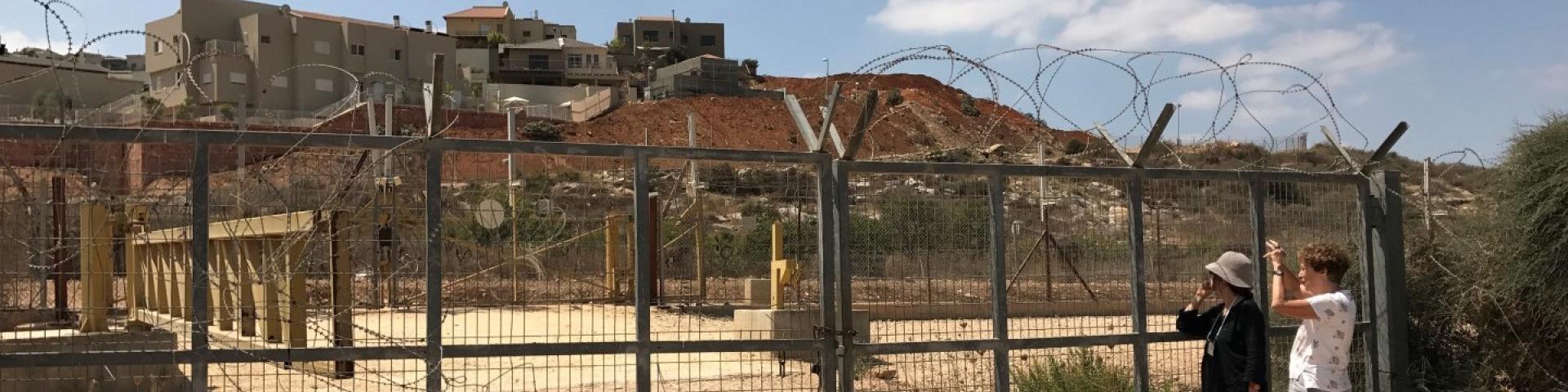
'Einabus
09:30 We left from the Rosh Ha’ayin train station.
It’s unusual to see four armed soldiers stationed next to the traffic light at the junction of Highway 5 and the road to Emanuel, stopping Palestinian cars for inspection.
10:00 Hars. Because of a lack of coordination we weren’t told that the elections which were to have been held in the club last Tuesday were postponed until today. So the English class won’t be held for the second consecutive week. That’s too bad.
Our tour:
10:15 We leave Hars to drive to Burin. On our way we go through Qira, Zeita, Jama’in and Einabus. They still seem half asleep, despite the hour. Little traffic, few people on the street.
10:45 Huwwara. Life here is bustling. Most shops are open, some with show windows and colorful signs. Cars and taxis drive on the main street. Seemingly a quiet town, living calmly. And then we reach the checkpoint. We see a few soldiers in the watchtower. A large red sign (like the ones already described in other Machsom Watch reports) declares: “Israelis entering Area A endanger their lives and commit a criminal offense” – no less…
11:00 Burin. We came to gather information about an incident that had occurred after villagers had erected tents on village land and were attacked by soldiers. A number of men stand next to the Palestinian Authority building; we ask them questions: the army came to dismantle the tents (reminder: they were erected on land belonging to the village!) and used tear gas when it met with resistance. As soon as the settlers from Beracha saw what was going on they came down from the hill to join the fun. We should note that the soldiers, to their credit, didn’t allow the settlers to approach the village. The soldiers arrested five people. One was badly beaten. His “sin” was that he carried a Palestinian flag. A child nearby was shot in the leg. Those arrested were taken to jail, “apparently to Megiddo.” There’s been no contact with them yet, or with an attorney, because it’s not yet clear whether they’ll be tried.
11:30 Tapuach junction. The checkpoint is operating, Border Police soldiers stopping cars. Road repairs on the way to Yitzhar. An armored military vehicle escorting the laborers. Certainly an efficient use of military manpower. The road at the Jit junction is open through Funduq to the Eliyahu crossing.
11:50 Back to Rosh Ha’ayin.
Natanya translating.
When we got to Kafr Kassem Nadin told us that the director of the centre at Kira had phoned to say that the women would not be coming to the centre because they were in mourning for a friend of theirs who had died. Therefore we decided to take a slightly longer tour.
10.00 Haris. The village was quiet and abandoned. Most of the shops were shut. It was rainy and misty. Outside the village in the olive orchards the almond trees were in bloom….beautiful.
10.10 Kif'l Harith. The village was completely empty. Here too we saw the almond trees in bloom.
10.15 Qira.There were a few people in the streets and little traffic.
10.25 Zeita. Here we saw no people or cars.
10.30 Einabus.Here there was more traffic, both of people and of cars. We went to the market in the middle of the village. Opposite us we saw the corpses of cows and sheep hung up on a line for sale and also for a meal. This is something we have not seen for a long time in the middle of a town.
10.35 Huwwara.We went through the village and came to the checkpoint. We saw a group of soldiers checking the cars entering Nablus. Most of the cars were allowed through immediately but sometimes one was stopped for a very long and detailed search. I asked the soldiers why there were such searches today and received the reply…"Routine checks." I asked the most senior soldier amongst them how he knew which car to check and he replies, "I already have experience. I have developed an insight and a knowledge which is particular to this." It is important to note that the opposite line of car which were coming from Nablus were not checked at all.
11.05 Za'tara/Tapuach CP. The checkpoint was almost empty……no soldier at all.
11.20 Shomron crossing….We go home.
09:30 We left from the Rosh Ha’ayin railroad station. The road is open, no military presence. Election posters for Otzma – the Kahanists – dominate the turn to the road to Hars.
10:00 We reach Hars. As it was last week, this week also the club is filled with woman making handicrafts, paid by an international organization. Their projects are donated primarily to children in poor families.
The women’s English class is held in a side room. The beginning of the class is devoted to the Israeli elections – a way of teaching a basic, relevant vocabulary. A discussion about democracy begins, comparing parties in Israel and in Palestine. It turns out that the lack of trust in the current leadership is common to both populations…
The women then receive a text about a boy genius and a graph of the distribution of IQ scores. There’s great interest. The importance Palestinian mothers assign to education and excellence in school is again obvious.
The circuit:
10:00 We leave Hars via Huwwara. We see two soldiers. Traffic flows without interference.
10:40 Burin. Children still on winter vacation play in the streets. Many shops are open, the atmosphere calm. The other villages – Kifl Hars, Qira, Zeita, Jama’in and Einabus – are also calm. Just an ordinary weekday, may there be many such. On our way back, at the Tapuach junction, two soldiers in position. No inspections. And surprise: Among the expected election posters displayed all around is one for “HaTnu’a – Tzipi Livni.” Well done!
12:00 We leave Hars. A few requests before we go. The first – to teach Hebrew. We asked them to prepare a list of participants’ names for next week and then we’ll look into it. The second – a mother seeking medical help for her daughter who suffers from atrophied muscles. We promised to check with Physicians for Human Rights.
There’s no military traffic at all on our way back to Rosh Ha’ayin. We even go through the checkpoint without being asked the question we’re always asked – “Where are you from?”
Later today each of us will exert her democratic right – vote, and pray for change.
09:30 We left in Nadim’s car from the Rosh Ha’Ayin train station. This time we constituted a “multitude”: Petahya, Rachel Afek and Riki also joined us on their way to Zeita.
10:00 The English class begins. A few new women attended; it’s beginning to be crowded. Today’s topic: the UN declaration on admitting Palestine as an observer. We taught many relevant words and concepts. Great excitement.
The class today lasted only for an hour and a half instead of two hours because we were late leaving Rosh Ha’Ayin.
10:00 Our circuit: we left Hars, drove through Kifl Hars and Qiriya, Zeita, Jama’in, Einabus. They’re all quiet, no military vehicles, life proceeds slowly.
10:40 Huwwara checkpoint: There’s a change. Concrete blocks have been placed around the guard tower and the surrounding plaza has been expanded. What does that mean? We should follow up. This week as well a soldier was seen sitting with his weapon at the bus stop leading to the Beracha settlement. Soldiers get out of a jeep and set up a flying checkpoint at the Yitzhar junction. They stop a Palestinian vehicle, inspect it inside and out.
A military jeep stands next to the parking lot at the Tapuach junction. We see no soldiers.
11:30 Back to Hars, and from there to Rosh Ha’Ayin.
10:15 Haris: There is little traffic and almost no one in the streets.
10:20 Kifl Haris: The village is deserted…silent
10:25 Qira: The village is quiet and deserted. We drove to the home of the club’s coordinator. She greeted us happily and joined us to drive to the club. It’s clean, organized but empty (after a three-month break). A few more women joined us immediately and with the help of Nadim who translated we arranged to continue our activities. We agreed on dates until Passover (afterwards – we’ll see what happens…). We drove the coordinator home and continued our circuit.
11:15 Zeita: This village is almost deserted as well. All the shops are closed except for grocerys, and we hardly see anyone. We saw children returning from school – why so early???
11:25 Jamma’in: It’s quiet and deserted here also, except for a single grocery.
11:35 Einabus: Ditto.
In general: We should mention that in all the localities we drove through today the streets were clean – far more than in years past, There were no overflowing garbage cans nor refuse strewn in the street.
11:45 Huwwara: Most of the shops are open and there’s quite a bit of traffic on the streets, both cars and pedestrians. We saw a military jeep at the Yitzhar junction.
Huwwara checkpoint: We saw a large truck carrying concrete blocks, a crane alongside unloading them, and two military jeeps. We asked the soldiers what’s being built; they said the “soldiers’ compound” is being enlarged. We asked why; they said so more soldiers could be stationed there. We asked whether the checkpoint will again be closed. They didn’t know.
We drove back to Huwwara. We saw a soldier in the tower at the turn-off to the Beracha settlement and other by the side of the road. A military jeep parked at the Yitzhar junction.
12:20 Za’tara: The checkpoint is quiet. There are a few soldiers at the guard post.
12:30 We returned via the Shomron crossing.
8:45 am: We entered the territories through the Shomron Gate. We decided to drive through
Ariel to see if there was anything new there, and also
as Tamar had never been there. There is a large new neighborhood on a hill farther to the east of the built up area.
Huwarra: The checkpoint was open and cars were driving through freely in both directions. An army jeep was standing in the parking lot.
Four soldiers were standing and sitting near the jeep looking entirely bored. They barely even glanced at us.
The checkpoint at Awarta was open and empty. We drove through Awarta hoping to be able to talk to our contact there. His workshop was
open but empty. We continued through Huwarra and Einabus. In Urif we saw a family harvesting olives. We stopped to talk to them and
to take pictures. It was a delightful Shahada family activity. A half year old baby sat in a swing-chair as his mother, aunt and grandmother
hit the trees to bring down the olives, and his father handled the heavy bags full of the fruit. The baby quietly watched the activity going on
around him.
We drove through Jammain, Zeita, Kira, Kif'l Hareth and Haris. Life seemed to be going on quite normally. We saw a few more groups harvesting
olives. At 11:15 we left through the Shomron Gate.
.
We took Highway 5 to Za’tara. The parking lot is almost empty; one military vehicle, and no soldiers in the positions.
On the way to Huwwara we saw a military jeep parked before the turn to Yitzhar, but there was no military traffic, nor were there soldiers at the checkpoints and traffic flowed.
The main road in Huwwara is being widened; foundations are being laid for streetlights. Residents told us it’s the municipality’s initiative.
The streets of Einabous and Jama’in are fairly empty; many residents must have gone to harvest olives.
We ended our circuit in the grove belonging to one of the members of the club where we hold classes, and helped a little with the harvest. We’ll now do so every week in different groves.
Hars, 09:45 No one on the street – silence. All the shops are closed, except for a few grocery stores. School has already begun. The streets are full of garbage; burned-out garbage containers litter the roadside along the main street. Nadim says the children set them alight. Only as we were leaving the village did we see two women dressed in black.
KIfl Hars, 10:05 The village itself is desolate, most shops are closed. We saw some people along the road repairing what appeared to be junked cars. A Palestinian flag flies in the central square.
Qira, 10:20 We arrived to teach the women at the club – English (Harriet) and yoga (Hagar). Only the coordinator was there. She said that yesterday and last night there was a power failure, and the women must be tired and distracted so they didn’t come. We waited; five more women dribbled in. We decided there was no point dividing them into two groups, that it would be better for Harriet to teach English to all six of them and for Hagar to drive around with Nadim. When we return we’ll decide, depending on the situation, how to continue.
The circuit:
Qira, 10:35 All the shops are closed, the whole town is dirty, desolate and silent (perhaps tearful and bleeding as well…)
Zeita, 10:40 Ditto. We didn’t see a living soul! A few cars passed on the way.
Jama’in, 10:50 Only a few shops open. We saw children returning from school (identifiable by their school uniforms). I asked why they’re coming home so early. Nadim didn’t know.
Einabus, 11:00 There are a few more signs of life here – more people on the street and more shops open. Children in school uniforms returning from school here also.
Huwarra, 11:10 Lots more activity here; the town is better organized. Most shops are open. Traffic is almost congested. Many people in the street, and children returning from school here also at this early hour. We drove to the checkpoint.
The checkpoint is quiet, no soldiers, cars flow through. One soldier on guard. When returned to the town center we saw a military jeep with soldiers parked on the roadside. We didn’t stop to ask what was going on.
Tapuach junction, 11:30 The checkpoint is empty, no soldiers. A lone soldier guards the hitchhiking station. We drove past Za’tara and back to the women’s club in Quira via Jama’in.
Qira, 11:40 Harriet was just finishing the lesson – all the students and the teacher were pleased. Because it was almost noon, the women looked very tired and the room was extremely hot (there’s no air conditioning, and almost no ventilation). We decided to forgo the yoga for the remaining five women. We arranged to meet again in two weeks (next week is Rosh Hashana). We asked them to come at 10:00.
12:10 Back home via the Shomron checkpoint.
Translator: anna K.
10:00 – Hares, Kif'l Haret' and Kira. At this hour the roads are empty. Only a few shops are open. There is no sign of army presence.
10:20 – we drove to Zeita – to our meeting with the local women.
13:00 - Jama'in and Inabus - the businesses are open, the road is being enlarged and new lightening is prepared for all its length.
At Huwwara village many businesses are open, the road is busy and men are sitting in the cafes.
At Huwwara CP the traffic flows in both directions, there are not soldiers at the passageways. In the direction of Nablus the road is being repaired. Near the hitchhikers station, at the way up to the Beraha settlement, a soldier stands and guards women settlers who probably are waiting for transportation. This, ins addition to the soldiers who man the two watch towers.
14:00 – At Burin we have fixed an appointment with a woman whose son had been arrested a few months ago. The son is still in detention, prior to the trial, and she is worried that he doesn't eat enough. She told us that the day before, at 02:30 in the morning again 40 soldiers entered the village and detained another boy from the last high-school class, of which a few pupils have already been detained in the last month for allegedly having thrown stones. All this happened as a result of the denouncement of one boy.
14:50 At Za'tara there are no soldiers.
About 10 kms after we passed the Samaria Gate we were suddenly stopped in a traffic jam as a result of a flying CP which was set up by soldiers not far from us. 3 soldiers arrived running, stopped a private car with an Israeli number plate in which there was a couple of Palestinians, probably Israeli citizens, who, judging by their attire looked Bedouin. There were other passengers in the car, we couldn't make out whether they were children or adults. The passengers looked scared and so did the soldiers, who, so it seemed received at this very moment the order to stop them. One of the soldiers took the car keys from the driver and began checking the papers. After about 10 minutes the road was opened, but the "suspect" car was ordered by the soldiers to stand at the side of the road. We are not sure what the reason for the stopping of the car was and especially why soldiers and not the blue police were summoned.