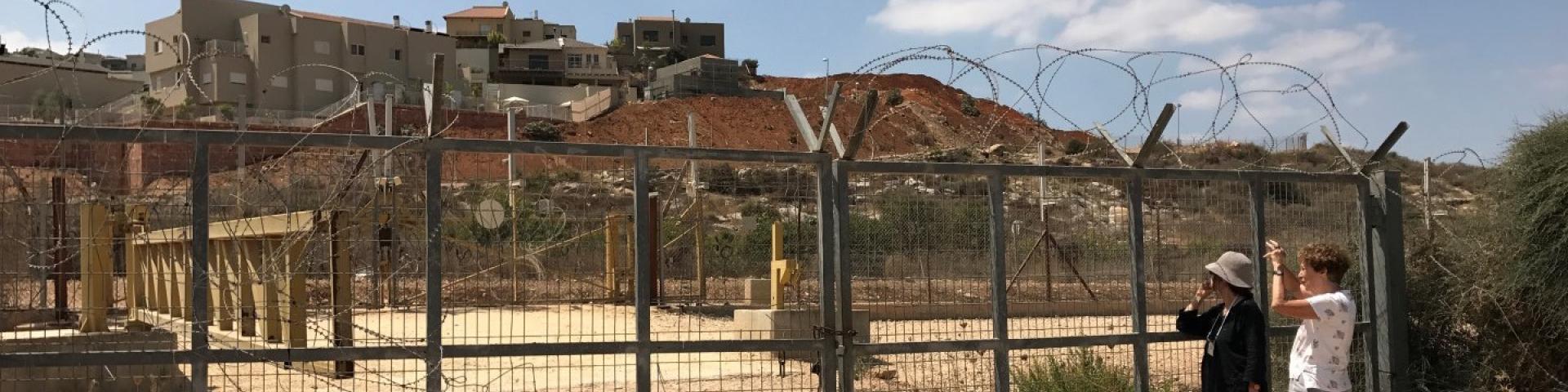
Burin (Yitzhar)
Translation: Suzanne O.
On the radio they talk about the budding Intifada – around Nablus only the almond trees are in bud.
Azzun Atma
6:20 a.m.
'Today the roadblock is not good' say the labourers. It turns out that one of the computer stations is not working and the exit queue moves very slowly. Tens of people crowd around the turnstiles. According to the labourers the waiting time is over an hour. The soldiers are not prepared to put in place someone to take notes manually. According to them their business is to take care of security and order not the welfare of the labourers.
At the entrance to the roadblock there is a new red sign. It does not prohibit the entrance to the village, just warns that it is dangerous for Israelis to enter. Is this not pronouncing a verdict?
Sha'ar Shomron
6:40 a.m.
There is no police presence at the exit from Israel.
Za'tara/Tapuach
7:00 a.m.
There are no soldiers in the checkpoints.
Almost without our noticing it the settlers' buffet in the car park, which has been there for years, has been dismantled. One of those waiting for a lift says it has been removed because it had no licence. Has the law of the land reached settler country?
Yitzhar/Borin roadblocks
There is no military activity.
Beit Furik
7:25 a.m.
A military vehicle is parked at the side but does not interfere with the flow of traffic.
In the village itself the children are on their way to school. They have not heard on the Israeli radio that no schools are open on the West Bank so that the children are free to throw stones.
Awarta
The yellow barrier still bars the crossing.
Huwwara
7:30 a.m.
The roadblock is not staffed.
On the way up to Bracha – a soldier.
Za'tara/Tapuach
8:00 a.m.
Not staffed.
Sha'ar Shomron
Heavy traffic of lorries exiting.
Translator: Hanna K.
A journey in the landscapes of Ruben and Guttman (Israelis painters) – if one ignores the army and the settlements
06:20 Azzun Atma: A calm CP. It seems the squadron became adjusted to its assignments and the soldiers are less tense. There is no long queue of waiting people. The soldiers allow the workmen to pass the turnstile and to approach the checking computers and thus the waiting time is shortened. A magnometer was installed and we returned to the well known sights of unfastened belts and emptying of the pockets. This adds another minute of delays on the way to the contractor's car.
SamariaPassage: There is no police at the exit from Israel.
07:05 Za'tara/Tapuah: There are no soldiers at the checking posts. A group of border-policemen watches from the nearby hill.
Yitzhar/Burin CPs: A military jeep waits on the roadside.
07:25 Beit Furik: No soldiers.
The streets of the village teem with children on their way to school, the girls going up the hill and the boys going down and all are of course in the middle of the road because nobody has heard here about sidewalks.
07:30 Awarta: The yellow arm still blocks the passage.
07:30 Huwwara: The CP is not manned. On the road up to Beraha settlement there is a soldiers.
Yitzhar/Burin CPs: The jeep went on its way.
08:00 Za'tara/Tapuah not manned.
Samaria Passage: Very sparse traffic.
09:30 We left from the Rosh Ha’ayin train station.
It’s unusual to see four armed soldiers stationed next to the traffic light at the junction of Highway 5 and the road to Emanuel, stopping Palestinian cars for inspection.
10:00 Hars. Because of a lack of coordination we weren’t told that the elections which were to have been held in the club last Tuesday were postponed until today. So the English class won’t be held for the second consecutive week. That’s too bad.
Our tour:
10:15 We leave Hars to drive to Burin. On our way we go through Qira, Zeita, Jama’in and Einabus. They still seem half asleep, despite the hour. Little traffic, few people on the street.
10:45 Huwwara. Life here is bustling. Most shops are open, some with show windows and colorful signs. Cars and taxis drive on the main street. Seemingly a quiet town, living calmly. And then we reach the checkpoint. We see a few soldiers in the watchtower. A large red sign (like the ones already described in other Machsom Watch reports) declares: “Israelis entering Area A endanger their lives and commit a criminal offense” – no less…
11:00 Burin. We came to gather information about an incident that had occurred after villagers had erected tents on village land and were attacked by soldiers. A number of men stand next to the Palestinian Authority building; we ask them questions: the army came to dismantle the tents (reminder: they were erected on land belonging to the village!) and used tear gas when it met with resistance. As soon as the settlers from Beracha saw what was going on they came down from the hill to join the fun. We should note that the soldiers, to their credit, didn’t allow the settlers to approach the village. The soldiers arrested five people. One was badly beaten. His “sin” was that he carried a Palestinian flag. A child nearby was shot in the leg. Those arrested were taken to jail, “apparently to Megiddo.” There’s been no contact with them yet, or with an attorney, because it’s not yet clear whether they’ll be tried.
11:30 Tapuach junction. The checkpoint is operating, Border Police soldiers stopping cars. Road repairs on the way to Yitzhar. An armored military vehicle escorting the laborers. Certainly an efficient use of military manpower. The road at the Jit junction is open through Funduq to the Eliyahu crossing.
11:50 Back to Rosh Ha’ayin.
Natanya translating.
The good news is that there has been much rain and the almond trees are in bloom.
6.15 Azzun Atma. It's raining all the time. There are a few workers next to the turnstiles and they go through quickly. The "Kfir" regiment's soldiers are welcoming. The sergeant tells us that this morning when they came to open the checkpoint 50 people were already waiting but now there are fewer and they go through quickly.
Shomron crossing.There are no police at the exit from Israel.
7.00 Za'tara/Tapuach. There are no soldiers at the checking posts.
At the checkpoints of Burin/Yizharno military activity.
7.20 Beit Furik.No soldiers
In the streets of the village the rain washes the streets and we do not see the children going their way.
Awarta.The yellow bar is still blocking the road. Also the large boulder is still in the middle of the road.
7.30 Huwwara CP.is not manned. The flags at the top of the tower have been replaced.
At the ascent Braha settlement is a soldier.
Za'tara/Tapuach CP. Two soldiers shelter from the rain at the post and do not stop the small flow of traffic.
Shomron crossing.The checking is quick as allways.
09:30 We left from the Rosh Ha’ayin railroad station. The road is open, no military presence. Election posters for Otzma – the Kahanists – dominate the turn to the road to Hars.
10:00 We reach Hars. As it was last week, this week also the club is filled with woman making handicrafts, paid by an international organization. Their projects are donated primarily to children in poor families.
The women’s English class is held in a side room. The beginning of the class is devoted to the Israeli elections – a way of teaching a basic, relevant vocabulary. A discussion about democracy begins, comparing parties in Israel and in Palestine. It turns out that the lack of trust in the current leadership is common to both populations…
The women then receive a text about a boy genius and a graph of the distribution of IQ scores. There’s great interest. The importance Palestinian mothers assign to education and excellence in school is again obvious.
The circuit:
10:00 We leave Hars via Huwwara. We see two soldiers. Traffic flows without interference.
10:40 Burin. Children still on winter vacation play in the streets. Many shops are open, the atmosphere calm. The other villages – Kifl Hars, Qira, Zeita, Jama’in and Einabus – are also calm. Just an ordinary weekday, may there be many such. On our way back, at the Tapuach junction, two soldiers in position. No inspections. And surprise: Among the expected election posters displayed all around is one for “HaTnu’a – Tzipi Livni.” Well done!
12:00 We leave Hars. A few requests before we go. The first – to teach Hebrew. We asked them to prepare a list of participants’ names for next week and then we’ll look into it. The second – a mother seeking medical help for her daughter who suffers from atrophied muscles. We promised to check with Physicians for Human Rights.
There’s no military traffic at all on our way back to Rosh Ha’ayin. We even go through the checkpoint without being asked the question we’re always asked – “Where are you from?”
Later today each of us will exert her democratic right – vote, and pray for change.
Translator: Hanna K.
At Azzun Atma the agricultural workers complain that there is a deterioration regarding authorizations for leaving the village given by the authorities.
06:15 Azzun Atma: A short queue, not many cars are waiting for the workers. People leaving say that this week "the CP is good". The soldiers of the "Kfir" regiment do not enable us to stand within the site. Clear signposts indicate to the workmen where to enter and from where to leave. Most of them take shelter in the newly erected hide-away because of the cold.
One of the workers complained that the policy of supplying authorizations to agricultural workers has changed. In the past his families received up to eight authorizations to leave and work in their fields which are situated beyond the CP. Now they give fewer permits and it is difficult for him to fulfill his workload.
06:40 Shomron crossing:The work has been completed. There is no police at the exit from Israel.
Za'tara/Tapuah: There are no soldiers at the checking posts, only in the posts around it.
The Yitzhar/Burin CPs: There is no military activity.
07:20Beit Furik: There are no soldiers. The streets of the village are quiet the children are on winter holiday.
Awarta: The yellow arm still blocks the passage. The big rock still lies in the middle of the road.
07:30 Huwwara: The CP isn't manned.
On the way up to Beraha settlement there is a soldier. There is one opposite the hitch-hiking station too.
In the square – energetic development work is going on. In its center a building is being erected, which simulates an arched archeological site, and around it there are olive trees. For the glory of the state of the settlers.
Za'tara/Tapuah: There are no soldiers at the posts.
Shomron crossing: The cheking is quick as usual.
Natanya translating.
There is a strike of the civil servants on the West Bank because their salaries have not been paid. The roads are empty of children going to school.
06.25 Azzun Atma Maybe because of the promised rain or because of the efficiency of the soldiers the line is not especially long. It is good that the sheds on both sides have been completed and both Palestinians and soldiers are protected from the winter weather.
The Shomron crossing. There are no police at the exit from Israel.
6.55 Za'tara/Tapuach. The soldiers are at their posts but do not interfere with the traffic.
Checkpoint Yizhar/Burin. No army activity
7.20 Beit Furik. No soldiers
7.25 Awarta. The yellow bar still blocks the passage. The big rock is also still in the middle of the road. Big red sign are placed opposite the no entry to Nablus and also opposite the turning to Awarta and warn against entering Area A.
7.30 Huwwara. We did not see soldiers in the sentry post.
At the ascent to Bracha settlement is a soldier.
7.45 Za'tara/Tapuach. Border police are at the posts. There is much traffic on the road as a result of a delay at the circle.
7.55 At the entrance of Marda is an army jeep.
There was no rain along the road in spite of the weather forecast but as we passed the Shomron crossing the heavens opened up. Do not the Palestinians deserve this?
Translator: Charles K.
11:30 Habla checkpoint. Fences and gates are closed. Not a soul around. A sign displays the hours when the checkpoint is open.
Coffee and plants with A. in the plant nursery. The hosts and guests change places around the table. A. is affable to everyone, funny, witty. He’s always happy to see Machsom Watch, always repeats that we’re the Palestinians’ ray of light. T., a friend who joins us, owns a fruit stand which the army keeps ordering him to move from place to place. Now it’s located at a gas station. His Hebrew is extraordinary he knows what each word means, the aphorisms roll off his tongue and it’s a pleasure to listen. He learned by himself, from reading and listening. A true autodidact.
A. tells us of an incident involving a group of soldiers at the Habla agricultural crossing. They were being photographed with a raised weapon against the background of the lengthening line of farmers waiting to go to work. He complained loudly that they’re not opening the gate on time and in response they fell upon him rudely, pushed him with the gun, threatened not to let him through. A. submitted a complaint to the Palestinian DCO; he reports on a prohibition against complaining to the Israeli DCO in order to avoid contact with the "Shabak" (the Israeli General Security Service).
13:00 Jayyous
We visited our friend N.’s family. He wasn’t home because he’d received an Israeli work permit. His wife and children were happy to see us. They showed us their lovely, renovated home. A second-hand shop run by his wife is on the main street. We made our contribution and drove on.
In Azzunwe stopped at Z’s second-hand store. Machsom Watch women are involved in his “rehabilitation,” helping to maintain the store and with medical aid. The army injured Z. psychologically and physically. People come to the shop, inspect the merchandise. They finger the clothing and footwear; the new salesperson behaves as if he’s always been there. We made our contribution and drove on.
15:00 Burin
We met M. so he could sign documents aimed at removing him from the security blacklist. We sat with his extended family whom we’d met on the trips to the beach. We made our contribution and drove on.
16:30 Huwwara
Huwwara is full of life. New shops have opened, others are under construction. The main road hasn’t been repaved like roads to other roads villages even though traffic is heavy and dangerous.
Chance meetings:
At Mazen’s coffee-and-sweets shop: David, our guest, is curious about the customers, wants to meet them and we use what spoken Arabic we’ve managed to acquire. We sat with three youths from Haris: a student, one who works in his father’s enterprise and a laborer in the settlements. After a few minutes we hear about a youth about 20 years older who’s already been jailed in Israel a few times: for six months when he was 16 and for a year when he was 18, because he threw rocks. He tells us about his time in jail, that the 60 days of interrogation at Jalameh were hard. Eight hours a day including beatings. Then he was transferred to Megiddo where he didn’t do anything. There are no longer classes in Israeli prisons like there used to be. All he did was sleep and wait for his family to visit. His mother visited once a month, for 45 minutes each time. According to his brother, he was jumpy when he came out. His behavior changed.
A man in the street who owns a chocolate shop invites us in. He tells of an incident this week in which settlers from Yitzhar entered his family’s olive grove. "Yesh Din" is dealing with it.
17:30 Za’tara.
Soldiers at the checkpoint aren’t watching the traffic. It flows.
We saw almost no military vehicles on the road all day.
18:00 Shomron checkpoint
Our driver (Amira’s brother) spoke English, we hadn’t removed the banner and he had a foreign passport so they took his documents for inspection and sent us to the vehicle inspection area.
They asked us to empty the car. Flats of plants we had bought olive oil, etc. They inspected and scanned everything. The car was checked top, bottom, within.
The black hibiscus plant received special treatment: a security man donned gloves, took two Q-tips and stuck them into the pot’s earth. Then he entered the laboratory, together with three more security people.
We were released after about 40 minutes. As we burst out laughing from how seriously they conducted the inspection, the security people told us earnestly, “We’re keeping the country safe…”
The Chabad menorah is still lit at the Shomron gate. It’s to remind us of other victories.
Translation: Suzanne O.
We didn't come out two weeks ago because of the war, this morning the children of Beit Furik gave us a warm welcome.
Azzun Atma
06:25
After a very rainy night there are a lot of puddles in the improvised car park but there are only a few labourers awaiting transport. Many thought that there would not be any work today because of the rain. On the other side of the road there are no labourers at all waiting for the crossing examination.
The whole site has had a serious makeover. The tent awning has been reinstated over the check point and, for the first time, two awnings have been erected – one for labourers leaving the village and the other, long and roomy, for labourers returning in the evening. Now, say the labourers, only toilets are missing.
From our experience when the site reaches its ultimate goal, it means that it will soon close.
Shomron Crossing
A system of speed humps has been installed which causes the cars to cross very slowly.
Za'tara/Tapuach
07:20
We didn't see any soldiers in the positions. The Chanukah light which has stood for a few years in the middle of the roundabout now stands at the side.
There is heavy traffic up the hill.
Yitzhar/Borin roadblocks
There is no military activity. A civilian looking vehicle is parked for a good hour in one of the bays.
Beit Furik
07:35
There are no soldiers. The flag is also not flying.
Awarta
07:40
The yellow barrier still bars the crossing. Someone has rolled a large rock into the centre of the road so that it is difficult to approach the separate building.
Huwwara
07:45
We didn't see any soldiers in the lookout tower. There are no flags and even the lighting has finally been put out while it's not needed.
There is a soldier on the hill up to Bracha.
Za'tara/Tapuach
07:55
Border Police soldiers staff the positions, there is heavy traffic on the main road.
Shomron Crossing
08:15
There are a lot of police and security forces on the road leaving Israel. It is not clear what their intention is.